
These star-packed love letters to the troops, from Hollywood during WWII.
90 old time radio show recordings
(total playtime 43 hours, 48 min)
available in the following formats:
2 MP3 CDs
or
44 Audio CDs
Text on OTRCAT.com ©2001-2026 OTRCAT INC All Rights Reserved. Reproduction is prohibited.


Mail Call simply could not come often enough. There could be no better medicine from the strain of being on the front lines or the boredom of long hours waiting for something to happen. The most important thing to come on-board a Navy ship when coming into port were the bags of mail, sometimes weeks old, but filled with news from loved ones back home. True, sometimes that news was a dreaded "Dear John" letter, but more often it was perfumed well-wishes from a Sweetheart, or even just "kitchen-table gossip" from Mom. Often the letter would be tucked into a uniform pocket, closest to the soldier or sailor's heart, to be read and reread when ever there was time for a break.
This was the spirit of the AFRS program Mail Call. The program was a love letter to the troops. Even though it featured many of the most popular and highest paid talent in Hollywood (all providing their services for free to AFRS), the program was not available to the folks back home.

Chester Lauck, Bob Wills, Norris Goff (1943)
The Armed Forces Radio Service was established in the early months of WWII. Before AFRS was officially established, Command Performance began production March 1, 1942. The Networks also provided shows for the service (with the commercials removed). AFRS produced a number of their own comedy variety programs at their Hollywood Studios, such as G.I. Journal, Jubilee, and G.I. Jive, along with Mail Call.
The guest stars include comedians Bing Crosby, Nelson Eddy, Jack Benny, Tito Guizar, Tony Martin, Harpo and Groucho Marx; starlets Cass Daley, Betty Grable, Dinah Shore, Dorothy Lamour, Claire Trevor, Tallulah Bankhead, Bette Davis, Betty Hutton, Marilyn Maxwell, Ida Lupino, Joan Davis, and Judy Garland; and comic duos Burns and Allen, among others.
See also the Command Performance and Request Performance.
Text on OTRCAT.com ©2001-2026 OTRCAT INC All Rights Reserved. Reproduction is prohibited.
You have reached the maximum number of votes for a unregistered user.
Please login or create a new account to continue...
You have reached the maximum number to down votes in this page.
Filenames of old time radio shows which are dated as yy-mm-dd. For example:
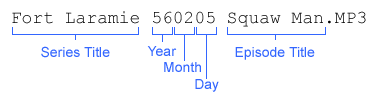
This episode from the series "Fort Laramie" was broadcast on February 5, 1956 with the episode title "Squaw Man"
Filenames of old time radio shows which are dated as yy-mm-dd. For example:
This episode from the series "Fort Laramie" was broadcast on February 5, 1956 with the episode title "Squaw Man"
Mail Call Disc A001
|
Add Audio CD to Cart - $5.00 |
Mail Call Disc A002
|
Add Audio CD to Cart - $5.00 |
Mail Call Disc A003
|
Add Audio CD to Cart - $5.00 |
Mail Call Disc A004
|
Add Audio CD to Cart - $5.00 |
Mail Call Disc A005
|
Add Audio CD to Cart - $5.00 |
Mail Call Disc A006
|
Add Audio CD to Cart - $5.00 |
Mail Call Disc A007
|
Add Audio CD to Cart - $5.00 |
Mail Call Disc A008
|
Add Audio CD to Cart - $5.00 |
Mail Call Disc A009
|
Add Audio CD to Cart - $5.00 |
Mail Call Disc A010
|
Add Audio CD to Cart - $5.00 |
Mail Call Disc A011
|
Add Audio CD to Cart - $5.00 |
Mail Call Disc A012
|
Add Audio CD to Cart - $5.00 |
Mail Call Disc A013
|
Add Audio CD to Cart - $5.00 |
Mail Call Disc A014
|
Add Audio CD to Cart - $5.00 |
Mail Call Disc A015
|
Add Audio CD to Cart - $5.00 |
Mail Call Disc A016
|
Add Audio CD to Cart - $5.00 |
Mail Call Disc A017
|
Add Audio CD to Cart - $5.00 |
Mail Call Disc A018
|
Add Audio CD to Cart - $5.00 |
Mail Call Disc A019
|
Add Audio CD to Cart - $5.00 |
Mail Call Disc A020
|
Add Audio CD to Cart - $5.00 |
Mail Call Disc A021
|
Add Audio CD to Cart - $5.00 |
Mail Call Disc A022
|
Add Audio CD to Cart - $5.00 |
Mail Call Disc A023
|
Add Audio CD to Cart - $5.00 |
Mail Call Disc A024
|
Add Audio CD to Cart - $5.00 |
Mail Call Disc A025
|
Add Audio CD to Cart - $5.00 |
Mail Call Disc A026
|
Add Audio CD to Cart - $5.00 |
Mail Call Disc A027
|
Add Audio CD to Cart - $5.00 |
Mail Call Disc A028
|
Add Audio CD to Cart - $5.00 |
Mail Call Disc A029
|
Add Audio CD to Cart - $5.00 |
Mail Call Disc A030
|
Add Audio CD to Cart - $5.00 |
Mail Call Disc A031
|
Add Audio CD to Cart - $5.00 |
Mail Call Disc A032
|
Add Audio CD to Cart - $5.00 |
Mail Call Disc A033
|
Add Audio CD to Cart - $5.00 |
Mail Call Disc A034
|
Add Audio CD to Cart - $5.00 |
Mail Call Disc A035
|
Add Audio CD to Cart - $5.00 |
Mail Call Disc A036
|
Add Audio CD to Cart - $5.00 |
Mail Call Disc A037
|
Add Audio CD to Cart - $5.00 |
Mail Call Disc A038
|
Add Audio CD to Cart - $5.00 |
Mail Call Disc A039
|
Add Audio CD to Cart - $5.00 |
Mail Call Disc A040
|
Add Audio CD to Cart - $5.00 |
Mail Call Disc A041
|
Add Audio CD to Cart - $5.00 |
Mail Call Disc A042
|
Add Audio CD to Cart - $5.00 |
Mail Call Disc A043
|
Add Audio CD to Cart - $5.00 |
Mail Call Disc A044
|
Add Audio CD to Cart - $5.00 |
Please wait...
COMMENTS
Franklin Verified Purchase
Leave a comment