


How to play shows on your PC:
How to play shows on your Apple Macintosh:
How To Order:
Three formats to order your favorite Old Time Radio shows:
1. DOWNLOAD ONLY option is only $5 per volume. Our entire catalog is now also available to "download only"--no CDs, no mail, no waiting! You can also choose a free sampler collection to download with your $10+ order. Once your paid order is complete, you'll have instant access to stream the individual episodes or download the entire collection as a .zip file in your account.
2. MP3 CDs are only $5.00 per disk and are full of hours and hours of great old time radio shows in the MP3 format (which must be played in a computer or special MP3 player device.) You'll also have instant access to stream and download your shows from your account once your paid CD order is received.
3. AUDIO CDs are only $5.00 per disk and contain up to 72 minutes of old time radio shows (or two 30-minute episodes) and play in any standard car or home stereo CD player.

The OTRCAT.com website automatically accepts orders internationally in US funds for:
Submit your order is with your credit card or paypal using our secure (SSL encrypted) shopping cart by simplying clicking the ADD TO CART button on any product page.
If you have any trouble completing your order or have questions, please email order@otrcat.com.
How do I get a free sampler CD?


Special Samplers:
Choose one of the following free special samplers on checkout:
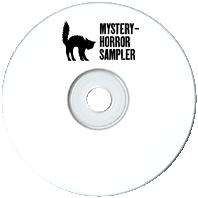
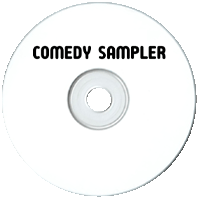
On checkout of your order $10+, you will be prompted to choose a FREE SAMPLER CD to be included in your order!
If you place an order for DOWNLOAD ONLY instead of AUDIO CD or MP3 CDs, you'll have access to stream/download a sampler cd of your choice with your order rather than receiving a MP3 CD through the mail.
What are shipping costs?

Postal Rates:
OTRCAT ships promptly within the United States!
Select your shipping method in shopping cart to be auto-calculated.
There are no shipping costs for instant DOWNLOAD ONLY.
US Orders: Free media mail shipping on orders of $50+
|
OTRCAT no longer ship CDs internationally.
Non-US listeners can still enjoy radio shows using our instant DOWNLOAD ONLY feature.
What is MP3?
Why Collect Old Time Radio Shows in MP3 format?
Listening to old time radio is easier than ever at OTRCAT.com. Our entire catalog is now also available on "download only"--no CDs, no mail, no waiting! With your paid order, you'll have instant access to your old time radio shows online.
Our full catalog of old time radio shows is available for order in three formats:
1.) Download Only: Save money! Online only, no CDs, no mail, no wait
2.) MP3 CDs: Affordable: Mp3 discs play in your computer disc drive and many MP3 players. Still have access to online content
3.) Audio CDs: Easy: plays in regular CD players. Still have access to online content
If you're reading this webpage on your computer with a CD drive, you already have everything you need to enjoy OTRCAT MP3 CDs; they are guaranteed to play on your computer.
Saving your old time radio show collection in the MP3 format is a great way to save old time radio shows for easy listening.MP3 is a sound compression format that allows up to 50+ hours of old time radio shows on just one MP3 CD compared to just 1 hour of recordings on an audio CD.

With the introduction of MP3 technology (in 1997), collections of old time radio shows that once filled rooms on reel-to-reel, cassettes, and transcription disks can now be stored on a small stack of MP3 CDs.
MP3 is an acronym which stands for Mpeg 1 Audio Layer 3. Because the lower fidelity of the original vintage recordings, there is miniscule loss of sound quality due to MP3 compression.
These disks play in your computer and many special MP3 player device.
While you're waiting for the archival quality CDs to arrive: OTRCAT make listening to old time radio easier than ever with instant download access to your paid old time radio show order. Return customers can login to your account and stream or download all the shows you have ordered from us online -- free!
MP3 CD Value Example from Mr. Alan Ladd:

Quick facts about OTRCAT MP3 CD's:

What is old time radio (OTR) and where does it come from?

OTR stands for Old Time Radio. Old Time radio shows were popular during the early to mid 20ths century and there was a radio set in almost every home in America. Classic radio recordings are highly entertaining for both old and young listeners.
The term old time radio encompasses radio recordings made usually between the mid 1920's through 1960. This "golden age of radio" included all genres of amazing recordings which were frequently performed live by top name performers.
Although much of radio history was lost (never recorded), existing episodes still in circulation were primarily stored by fans or sponsors of the program on transcription disk or reel-to-reel tapes. These recordings are encoded (converted from analog to digital format) from their original media into MP3 format for easier collecting, playback, and listening.
Old Time Radio shows are a varied group of people. Some otr fans listened to old time radio shows when they were first broadcast decades ago. However, there is a new generation of old time radio listener who is just now listening to classic old time radio recordings.
Factoids

Will these old time radio shows play in my MP3/DVD player?
Probably... but it depends on what brand and model of MP3/DVD player you own.
The good news is if you're reading this webpage on your computer, you already have everything you need to enjoy OTRCAT MP3 CDs; they are guaranteed to play on your computer.

For away from the computer listening, see a list of recommended MP3 players or general information about the MP3 format.
See also: how to listen to old time radio in your car.
Audio disks will play in any standard modern audio CD player at home or in your car.
What is the sound quality of these old time radio shows? What bitrate are they stored?

Although MP3 bitrates vary from series to series, our old time radio shows are stored at 32 kps to 64 kps.
By today's standards, these vintage recordings are relatively low-fidelity. There is little loss of sound quality due to MP3 compression at these bitrate setting. More important than the actual bitrate of the MP3 is the quality of the original media. OTRCAT strives to encode, collect, and organize the best quality recordings available.
You can listen to a full episode from most series to sample to the sound quality online. Near the top right of a log page, there is a sample episode that you can listen to a streaming show or download the MP3 file to your computer.
There are also new episodes every day on FREE OLD TIME RADIO DOWNLOADS PAGE.
Can these shows be transferred to audio cassette?

Another alternative is a MP3 CD player and a cassette adapter (or lower power FM tuner) which is a great way to play the actual MP3 CDs in the car; please click here to see a list of recommended MP3 players.
Can MP3 shows be transferred to audio cd?
Yes. You can rewrite the MP3's onto audio CD.
All our collections are available for purchase on audio CD from the website, but if you'd prefer to transfer MP3 to audio cd yourself: First copy the episodes you wanted to record onto you computer hard drive and use a program such as Nero or Easy CD Creator. Using a slower write-speed (such as 2x or 4x) and CD-R media (rather than CDRW disks) will insure a more probable successful write.
As an inexpensive alternative, see the list of recommended MP3 CD players that can play the disks directly for as little as $30-$40.
Why are the same episode listed more than once in the same series?
Even back in the golden era of radio, they had script 're-runs.' The producers of the many of the series frequently used the same popular script and rebroadcast or performed it on a later date (so it's usually the same or very similar script, but actually a different variation of the performance recorded). Popular scripts, movies, and short stories often appeared in multiple series.
Some collections include AFRS broadcasts (which are non-commercial) to be aired to servicemen overseas. Other episodes may be labelled with EC and WC would signify East Coast and West Coast broadcasts. These are different recordings reacted by the same actors and script for the different network airtimes. Additionally in a few series there are "Audition" episodes which are unaired broadcasts of the first time a series was performed. Many listeners are interested in these specific broadcasts, but if you are not, the beauty of digital recordings is you can skip the episode with a touch of a button and listen to the next broadcast.
What does "AFRS" stand for?

What does "Aud" mean?
"Aud" is short for "Audition program" (or sometimes labelled as episode "00") which were typically a rare test run of the script with voice actors which were not broadcast. These uniqie recordings can have different actors in their roles than when the series actually aired.
What does "transcribed" mean?

How are these radio shows dated?
Filenames of old time radio shows which are dated as yy-mm-dd. Each series has a list of episode at the bottom of the log page and each episode is identified by the actual filenames. For example:

This MP3 file would be a broadcast of: The series "Fort Laramie", broadcast on February 5, 1956 with the episode title "Squaw Man"
The broadcast date is in the format YYMMDD. The filenames help identify the individual episodes and often contain some or many of the following information including Series, Episode number, Episode title, and Airing Date.
To maximize compatibility with as many MP3 players as possible, OTRCAT does not use ID3 tags. If corrupted, ID3 can prevents playback in certain programs and external MP3 players.
How can I determine if an MP3 CD is defective?
Disks are guaranteed to play in your computer CDR drive with players such as VLC Player or WinAMP. Because every MP3 player has different playback specifications, it is possible some MP3 Players may be improperly decoding or reading the MP3 CD.

Possible reasons a MP3 player may refuse to play a MP3 CD:
Errors from your MP3 player such as "Error" or "Can't read disk" or "No MP3" does not confirm the disk is defective.
If all other disks play in your MP3 player, but the MP3 player will not play a single disk, this alone does not confirm the disk itself is defective.
To confirm the media is defective, please first try the disk in your computer and let us know the exact error message you receive to confirm the disk is defective.
Why do the filenames appear jumbled on my Macintosh computer? (iOS 9 Users)
Listeners using a Macintosh computer with System 9 or older may need a program to fully decipher the file name of the shows. A free joilet extension is available which enhances the way your Macintosh computer can read CD-ROM's. Without this joilet extension, file names may appear abbreviated which will make it harder to decipher the episode titles (although the shows will still play fine). This file name problem has been resolved in by Apple in OS X.
Why do shows skips or repeat on my Apple mobile product (iOS11)?
If you're using an Apple mobile product such as an iPad, iPhone, or iPod, it is a known software issue that the Apple products will 'fall asleep' and disconnect when streaming mp3 from html5 from the web after about 4-5 minutes. Unfortunately this disconnect may cause the episode may stutter, stop or repeat itself. To solve the issue, instead of streaming the show you can download the full episode for easy listening.
How are these CDs labeled?
 All CDs come with labelled with silk-screened black lettering graphics and come in paper sleeves with clear plastic to protect them during shipping.
The radio shows are stored on Mitsui and Taiyo Yuden media which is the top quality CDR media for longest archival life.
Because the label is silk-screened directly on the disk, there is no sticky label to jam in CD drives.
Unlike inkjet printed labels, these attractive silk-screened label will not run, fade, deteriorate, or shorten the lifespan of the media.
Is Old Time Radio available on USB thumbdrive / flash drives / hard drive?
No. Sorry, we do not provide shows as a subscription service or on USB thumb drives, flash drives, hard drives or SD cards. Radio shows are available as Audio CDs, MP3 CDs and Instant Download. Customers order the shows on MP3 CDs or instant downloads and can copy the shows to their own USB flash drives for listening convenience.
How are these collections updated or upgraded?

Upgraded collections are available at up to 40% off for previous purchasers. You can view your complete order history which shows you all the possible upgrades and discounts for your account by:
1. Login to My Account
2. Click tab: My Purchased Disks
Once you are logged in, you can also review a list of all your previous orders. If a collection has been updated since you ordered, you can buy the new updated collection at a 40% discount through your web portal login.
Do you have an old time radio app?
No iPhone or Android app download is required! Use your browser to visit the optimized and secure OTRCAT.com website on your Android, Apple, or Windows computer, tablet, and mobile phone. You can order, download and stream the shows directly to your desktop or mobile device without any individual app purchase or download.
You can create a home screen shortcut icon to your downloads on your iPhone/iPad by:
1. Tap the "Safari" icon and then navigate to https://www.otrcat.com/my-collection
2. Wait for the website to load and then tap the "Share" icon. The icon is an arrow coming out of a box.
3. Select "Add to Home Screen"
To create a home screen shortcut icon to your downloads on your Android phone/tablet by:
1. Tap the "Chrome" icon and then navigate to https://www.otrcat.com/my-collection
2. Wait for the website to load and then tap the three bar icon on top right
3. Select "Add to Home Screen"
How do I get OTRCAT.com coupons? How do I use a promo code?
To receive special coupon codes and discounts, please sign up for the OTRCAT newsletter which includes list of new articles, exclusive content, collections, and special offers available at OTRCAT!
To use a promo code you have received:
1. On the shopping cart page, click the link "Have a Promo Code?"
2. Enter the promo code and click "Add" button
3. Click "Checkout >>" button and complete your paid order
What is the OTRCAT refund policy?
Due to the nature of these recordings: once an order is placed, all sales are final. We do not provide refunds for download or CD orders. Our extensive collection is digitally transferred; any "flaws" in these 50-90 years old recordings are inherent in the original media and are not grounds for a refund.
What is the OTRCAT privacy policy?
OTRCAT is committed to protecting your privacy; we do not sell, trade, or rent your personal information to others. We only use the information we collect about you to process orders and to provide support and updates for our products.
OTRCAT respects your privacy. By entering your email address in the "join mailing list" "comment" or "checkout" form, you agree to sign up for the free OTRCAT email newsletter which you can unsubscribed at any time.
To protect consumer information, we use a secure server for collecting personal and credit card information. The secure server layer (SSL) encrypts (scrambles) all of the information you enter before it is transmitted. For additional security, credit card information is not stored locally (only passed encrypted to the credit card processor). All customer data we collect is protected against unauthorized access.
The site uses GeoLite2 database created by MaxMind. "Cookies" (which are small pieces of information that are temporarily stored by your browser on your computer's hard drive) are required for the OTRCAT shopping cart to function correctly.
Can I join the OTRCAT mailing list?

Enter your email address in the the form at the bottom footer of this page to receive the old time radio newsletter with new collections, discounts and special offers!
OTRCAT respects your privacy, your email addresses and
personal information are never revealed to any third party.
You can also follow us on social media for the latest updates and sales:
How can I contact OTRCAT?
OTRCAT does not offer phone support; if you have any questions, suggestions, or error corrections, please contact us by emailing order@otrcat.com.
OTRCAT
PO BOX 19234
LENEXA KS 66285
USA

