
In 1953 Sir Bertrand Russell, one of Britain's premier philosophers, gave a series of lectures on the implications of Living In An Atomic Age.
7 old time radio show recordings
(total playtime 1 hours, 39 min)
available in the following formats:
1 MP3 CD
or
2 Audio CDs
Text on OTRCAT.com ©2001-2026 OTRCAT INC All Rights Reserved. Reproduction is prohibited.

During the Second World War and the beginnings of the Cold War Network Radio presented a great deal of

Beginning on May 12, 1953, the Public Relations Department of the American Broadcasting Company presented a series of lectures by Noble Prize winner, Sir Bertrand Russell.
Bertrand Arthur William Russell, 3rd Earl was born in Wales in 1872. Russell began his study of higher mathematics at Trinity College in Cambridge in 1890. His lifetime of work would greatly influence logic, mathematics, set theory, linguistics, and philosophy. In the early 1900s he led "the revolt against Idealism" in Great Britain, and is credited as one of the founders of analytic philosophy. During
Given his controversial views, it is notable that his lectures would be presented to an American Network audience. Both American networks had presented many British produced programs through the
The most persuasive of the presentations is Sir Bertrand's summation in the seventh broadcast, "Reflections On Being Eighty." He summarizes his

For more compelling intellectual listening of the era, see also: America Town Meeting of the Air, American Forum of the Air, University of Chicago Roundtable and Speaking of Liberty.
Text on OTRCAT.com ©2001-2026 OTRCAT INC All Rights Reserved. Reproduction is prohibited.
You have reached the maximum number of votes for a unregistered user.
Please login or create a new account to continue...
You have reached the maximum number to down votes in this page.
Filenames of old time radio shows which are dated as yy-mm-dd. For example:
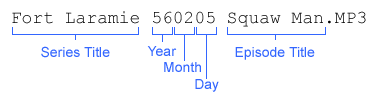
This episode from the series "Fort Laramie" was broadcast on February 5, 1956 with the episode title "Squaw Man"
Filenames of old time radio shows which are dated as yy-mm-dd. For example:
This episode from the series "Fort Laramie" was broadcast on February 5, 1956 with the episode title "Squaw Man"
Living in an Atomic Age Disc A001
|
Add Audio CD to Cart - $5.00 |
Living in an Atomic Age Disc A002
|
Add Audio CD to Cart - $5.00 |
Please wait...
COMMENTS
Be the first to comment on "Living in an Atomic Age"
Leave a comment