
best known for a one of the greatest Hard-boiled detective writers of all time including creating the famed protagonist Philip Marlowe.
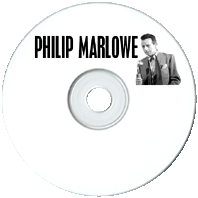
115 old time radio show recordings
(total playtime 58 hours, 36 min)
available in the following formats:
4 MP3 CDs
or
62 Audio CDs
Text on OTRCAT.com ©2001-2026 OTRCAT INC All Rights Reserved. Reproduction is prohibited.
Raymond Chandler
(1888 – 1959)

"When in doubt, have a man come through
the door with a gun in his hand."
--Raymond Chandler
A man fired by an oil company, a self-taught pulp writer, a witness to the rapid sprawl of Los Angeles in the early 20th century, Raymond Chandler was as hard-boiled as his prose.


Marlowe was brought to the airwaves in 1947 in The Adventures of Philip Marlowe. Gerald Mohr is the best-known voice of the detective.
In "The Persian Slippers," Marlowe is on the hunt for a disappeared wife; in "Where There's a Will," a map seems to point the may to $300,000; in "The Restless Day," Marlowe investigates the murder of an inventor; and in "The Unfair Lady," Marlowe pursues a bandit in a Mexican diamond mine.
Volume 1-3 of this collection are The Adventures of Philip Marlowe and Vol. 4 contains special episodes based on the Chandler stories from various series such as Hollywood Star Time, Lux Radio Theater, Molle Mystery Theater, and Suspense.
See also:
Text on OTRCAT.com ©2001-2026 OTRCAT INC All Rights Reserved. Reproduction is prohibited.
You have reached the maximum number of votes for a unregistered user.
Please login or create a new account to continue...
You have reached the maximum number to down votes in this page.
Filenames of old time radio shows which are dated as yy-mm-dd. For example:
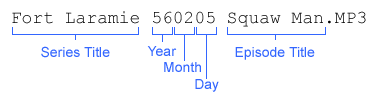
This episode from the series "Fort Laramie" was broadcast on February 5, 1956 with the episode title "Squaw Man"
Filenames of old time radio shows which are dated as yy-mm-dd. For example:
This episode from the series "Fort Laramie" was broadcast on February 5, 1956 with the episode title "Squaw Man"
Raymond Chandler Disc A001
|
Add Audio CD to Cart - $5.00 |
Raymond Chandler Disc A002
|
Add Audio CD to Cart - $5.00 |
Raymond Chandler Disc A003
|
Add Audio CD to Cart - $5.00 |
Raymond Chandler Disc A004
|
Add Audio CD to Cart - $5.00 |
Raymond Chandler Disc A005
|
Add Audio CD to Cart - $5.00 |
Raymond Chandler Disc A006
|
Add Audio CD to Cart - $5.00 |
Raymond Chandler Disc A007
|
Add Audio CD to Cart - $5.00 |
Raymond Chandler Disc A008
|
Add Audio CD to Cart - $5.00 |
Raymond Chandler Disc A009
|
Add Audio CD to Cart - $5.00 |
Raymond Chandler Disc A010
|
Add Audio CD to Cart - $5.00 |
Raymond Chandler Disc A011
|
Add Audio CD to Cart - $5.00 |
Raymond Chandler Disc A012
|
Add Audio CD to Cart - $5.00 |
Raymond Chandler Disc A013
|
Add Audio CD to Cart - $5.00 |
Raymond Chandler Disc A014
|
Add Audio CD to Cart - $5.00 |
Raymond Chandler Disc A015
|
Add Audio CD to Cart - $5.00 |
Raymond Chandler Disc A016
|
Add Audio CD to Cart - $5.00 |
Raymond Chandler Disc A017
|
Add Audio CD to Cart - $5.00 |
Raymond Chandler Disc A018
|
Add Audio CD to Cart - $5.00 |
Raymond Chandler Disc A019
|
Add Audio CD to Cart - $5.00 |
Raymond Chandler Disc A020
|
Add Audio CD to Cart - $5.00 |
Raymond Chandler Disc A021
|
Add Audio CD to Cart - $5.00 |
Raymond Chandler Disc A022
|
Add Audio CD to Cart - $5.00 |
Raymond Chandler Disc A023
|
Add Audio CD to Cart - $5.00 |
Raymond Chandler Disc A024
|
Add Audio CD to Cart - $5.00 |
Raymond Chandler Disc A025
|
Add Audio CD to Cart - $5.00 |
Raymond Chandler Disc A026
|
Add Audio CD to Cart - $5.00 |
Raymond Chandler Disc A027
|
Add Audio CD to Cart - $5.00 |
Raymond Chandler Disc A028
|
Add Audio CD to Cart - $5.00 |
Raymond Chandler Disc A029
|
Add Audio CD to Cart - $5.00 |
Raymond Chandler Disc A030
|
Add Audio CD to Cart - $5.00 |
Raymond Chandler Disc A031
|
Add Audio CD to Cart - $5.00 |
Raymond Chandler Disc A032
|
Add Audio CD to Cart - $5.00 |
Raymond Chandler Disc A033
|
Add Audio CD to Cart - $5.00 |
Raymond Chandler Disc A034
|
Add Audio CD to Cart - $5.00 |
Raymond Chandler Disc A035
|
Add Audio CD to Cart - $5.00 |
Raymond Chandler Disc A036
|
Add Audio CD to Cart - $5.00 |
Raymond Chandler Disc A037
|
Add Audio CD to Cart - $5.00 |
Raymond Chandler Disc A038
|
Add Audio CD to Cart - $5.00 |
Raymond Chandler Disc A039
|
Add Audio CD to Cart - $5.00 |
Raymond Chandler Disc A040
|
Add Audio CD to Cart - $5.00 |
Raymond Chandler Disc A041
|
Add Audio CD to Cart - $5.00 |
Raymond Chandler Disc A042
|
Add Audio CD to Cart - $5.00 |
Raymond Chandler Disc A043
|
Add Audio CD to Cart - $5.00 |
Raymond Chandler Disc A044
|
Add Audio CD to Cart - $5.00 |
Raymond Chandler Disc A045
|
Add Audio CD to Cart - $5.00 |
Raymond Chandler Disc A046
|
Add Audio CD to Cart - $5.00 |
Raymond Chandler Disc A047
|
Add Audio CD to Cart - $5.00 |
Raymond Chandler Disc A048
|
Add Audio CD to Cart - $5.00 |
Raymond Chandler Disc A049
|
Add Audio CD to Cart - $5.00 |
Raymond Chandler Disc A050
|
Add Audio CD to Cart - $5.00 |
Raymond Chandler Disc A051
|
Add Audio CD to Cart - $5.00 |
Raymond Chandler Disc A052
|
Add Audio CD to Cart - $5.00 |
Raymond Chandler Disc A053
|
Add Audio CD to Cart - $5.00 |
Raymond Chandler Disc A054
|
Add Audio CD to Cart - $5.00 |
Raymond Chandler Disc A055
|
Add Audio CD to Cart - $5.00 |
Raymond Chandler Disc A056
|
Add Audio CD to Cart - $5.00 |
Raymond Chandler Disc A057
|
Add Audio CD to Cart - $5.00 |
Raymond Chandler Disc A058
|
Add Audio CD to Cart - $5.00 |
Raymond Chandler Disc A059
|
Add Audio CD to Cart - $5.00 |
Raymond Chandler Disc A060
|
Add Audio CD to Cart - $5.00 |
Raymond Chandler Disc A061
|
Add Audio CD to Cart - $5.00 |
Raymond Chandler Disc A062
|
Add Audio CD to Cart - $5.00 |
Please wait...
COMMENTS
George Verified Purchase
Leave a comment