
Join Duke Ellington Orchestra in the live 1945 broadcasts from the 400 Restaurant on Fifth Avenue and 43rd Street in New York City.
57 old time radio show recordings
(total playtime 40 hours, 54 min)
available in the following formats:
2 MP3 CDs
or
45 Audio CDs
Text on OTRCAT.com ©2001-2026 OTRCAT INC All Rights Reserved. Reproduction is prohibited.

Duke Ellington followed a slightly different path to stardom than most other Jazzmen. A native of Washington D.C., his parents were both pianists, his mother playing parlor music while his father, who drew blue-prints for the Department of the Navy, specialized in operatic airs. As a youth he was far more interested in baseball (President Teddy Roosevelt would sometimes interrupt his horse rides to watch Ellington's team play) than the piano. When he began sneaking into pool halls as a teenager he heard the playing of pool-room pianists, which fired his passion for the instrument. From that time on he began to take his lessons seriously, and to draw upon a number of influences.

While still in his teens he began appearing with different bands in clubs in the Washington area, and in the early 1920's made the move to New York to break into the Harlem music scene. He survived by hustling pool during the day and playing what gigs he could find in the evening, often at rent parties. After a few months he returned to Washington, discouraged. But the call of the music couldn't be ignored. A gig in Atlantic City in 1923 led to a four year engagement at the Hollywood Club at 49th and Broadway. This is where Duke Ellington grew as a musician and artist.
After the Hollywood Club burned down and reopened as the Kentucky Club, Ellington took over as leader of the house orchestra. "Duke Ellington and his Kentucky Club Orchestra" soon grew into a ten piece outfit with a distinctive sound that combined the Harlem street rhythms and Ellington's expressive arrangements with exotic trombone wah-wahs and growls, squealing high trumpets, and sultry blues licks.
The Duke Ellington Orchestra survived the great depression, when many bands were being let go by the recording studios, but only through hard work touring and exposure on radio. Engagements at New York's Cotton Club exposed him to a European audience, but at home he was in competition with the likes of Benny Goodman, Tommy Dorsey, and Count Basie. Although the Duke could swing with the best, he felt constrained by the 3 minute limitation of the 78 rpm record side.
Finally, by the end of WWII, the music industry began to favor the easy to promote image of the solo vocalists like Sinatra, Bing Crosby, and Dinah Shore. Jazz itself began to move away from big bands.
These shows were mostly recorded at the 400 Restaurant on fifth Avenue and 43rd Street in New York City. They were adapted for use by the AFRS. The show was a "weekly concert", that features the Duke Ellington Orchestra at their high point.
For more jazz broadcasts, see also: Charlie and His Orchestra (Nazi Propganda), Date with the Duke, Eddie Condon Jazz Concert, Esquire Jazz Concert, Jubilee, Music Depreciation, Navy Swings, Live from Birdland, and New Orleans Jazz Band.
Text on OTRCAT.com ©2001-2026 OTRCAT INC All Rights Reserved. Reproduction is prohibited.
You have reached the maximum number of votes for a unregistered user.
Please login or create a new account to continue...
You have reached the maximum number to down votes in this page.
Filenames of old time radio shows which are dated as yy-mm-dd. For example:
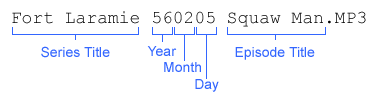
This episode from the series "Fort Laramie" was broadcast on February 5, 1956 with the episode title "Squaw Man"
Filenames of old time radio shows which are dated as yy-mm-dd. For example:
This episode from the series "Fort Laramie" was broadcast on February 5, 1956 with the episode title "Squaw Man"
Date with the Duke Disc A001
|
Add Audio CD to Cart - $5.00 |
Date with the Duke Disc A002
|
Add Audio CD to Cart - $5.00 |
Date with the Duke Disc A003
|
Add Audio CD to Cart - $5.00 |
Date with the Duke Disc A004
|
Add Audio CD to Cart - $5.00 |
Date with the Duke Disc A005
|
Add Audio CD to Cart - $5.00 |
Date with the Duke Disc A006
|
Add Audio CD to Cart - $5.00 |
Date with the Duke Disc A007
|
Add Audio CD to Cart - $5.00 |
Date with the Duke Disc A008
|
Add Audio CD to Cart - $5.00 |
Date with the Duke Disc A009
|
Add Audio CD to Cart - $5.00 |
Date with the Duke Disc A010
|
Add Audio CD to Cart - $5.00 |
Date with the Duke Disc A011
|
Add Audio CD to Cart - $5.00 |
Date with the Duke Disc A012
|
Add Audio CD to Cart - $5.00 |
Date with the Duke Disc A013
|
Add Audio CD to Cart - $5.00 |
Date with the Duke Disc A014
|
Add Audio CD to Cart - $5.00 |
Date with the Duke Disc A015
|
Add Audio CD to Cart - $5.00 |
Date with the Duke Disc A016
|
Add Audio CD to Cart - $5.00 |
Date with the Duke Disc A017
|
Add Audio CD to Cart - $5.00 |
Date with the Duke Disc A018
|
Add Audio CD to Cart - $5.00 |
Date with the Duke Disc A019
|
Add Audio CD to Cart - $5.00 |
Date with the Duke Disc A020
|
Add Audio CD to Cart - $5.00 |
Date with the Duke Disc A021
|
Add Audio CD to Cart - $5.00 |
Date with the Duke Disc A022
|
Add Audio CD to Cart - $5.00 |
Date with the Duke Disc A023
|
Add Audio CD to Cart - $5.00 |
Date with the Duke Disc A024
|
Add Audio CD to Cart - $5.00 |
Date with the Duke Disc A025
|
Add Audio CD to Cart - $5.00 |
Date with the Duke Disc A026
|
Add Audio CD to Cart - $5.00 |
Date with the Duke Disc A027
|
Add Audio CD to Cart - $5.00 |
Date with the Duke Disc A028
|
Add Audio CD to Cart - $5.00 |
Date with the Duke Disc A029
|
Add Audio CD to Cart - $5.00 |
Date with the Duke Disc A030
|
Add Audio CD to Cart - $5.00 |
Date with the Duke Disc A031
|
Add Audio CD to Cart - $5.00 |
Date with the Duke Disc A032
|
Add Audio CD to Cart - $5.00 |
Date with the Duke Disc A033
|
Add Audio CD to Cart - $5.00 |
Date with the Duke Disc A034
|
Add Audio CD to Cart - $5.00 |
Date with the Duke Disc A035
|
Add Audio CD to Cart - $5.00 |
Date with the Duke Disc A036
|
Add Audio CD to Cart - $5.00 |
Date with the Duke Disc A037
|
Add Audio CD to Cart - $5.00 |
Date with the Duke Disc A038
|
Add Audio CD to Cart - $5.00 |
Date with the Duke Disc A039
|
Add Audio CD to Cart - $5.00 |
Date with the Duke Disc A040
|
Add Audio CD to Cart - $5.00 |
Date with the Duke Disc A041
|
Add Audio CD to Cart - $5.00 |
Date with the Duke Disc A042
|
Add Audio CD to Cart - $5.00 |
Date with the Duke Disc A043
|
Add Audio CD to Cart - $5.00 |
Date with the Duke Disc A044
|
Add Audio CD to Cart - $5.00 |
Date with the Duke Disc A045
|
Add Audio CD to Cart - $5.00 |
Please wait...
COMMENTS
Colin Verified Purchase
Colin Verified Purchase
Jack Verified Purchase
Leave a comment