
Part big city adventure, part romance, part situation comedy, The Adventures of Maisie starring Ann Sothern was the story of a “liberated†single girl in post-War America.
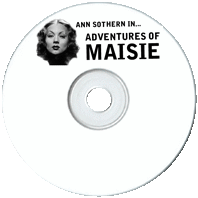
85 old time radio show recordings
(total playtime 41 hours, 22 min)
available in the following formats:
1 MP3 CD
or
43 Audio CDs
Text on OTRCAT.com ©2001-2026 OTRCAT INC All Rights Reserved. Reproduction is prohibited.
Situation comedy, based on MGMs "Maisie" films (1945 - 53)

MGM Studios had created the series of ten motion pictures based on a brash blonde with a heart "of spun gold." Maisie, the first in 1939, was from the book "Dark Dame" by the writer Wilson Collison, who did decades of scripting for the silver screen along with Broadway plays and magazine fiction.
From the first, MGM wanted Ann Sothern to play Maisie. She began in Hollywood as an extra in 1927. "Maisie and I were just together - I just understood her," Sothern, born Harriette Arlene Lake, said after several of the films made her a star.
Throughout the 1940s, the Maisie pictures continued to be released every couple of years. "Your pictures pay for our mistakes," Arthur B. Mayer told her. "And you'll just keep making Maisies as long as you do that."
In July, 1945, Ann took Maisie to radio in a half-hour weekly radio. Famed radio actor Elliott Lewis co-starred as boyfriend Bill, with other parts going to such seasoned radio players as John Brown and Lurene Tuttle. The series ran two seasons, and was revived in 1949 as a syndicated program, now called The Adventures of Maisie. Included in the repertory cast were Hans Conreid (later on Life with Liugi), Sheldon Leonard, Joan Banks, Elvia Allman, Bea Benadaret, and Sandra Gould.

Sothern, due in great part to the Maisie films type-casting, would ultimately admit she was "a Hollywood princess, not a Hollywood queen." But in its time, the Maisie series in film and on radio made her known and loved the world over. And for many of us, Ann Sothern was a beautiful and intelligent actress whose warmth and charm were singularly beguiling. She continued to do TV (Private Secretary, The Ann Sothern Show) and movie work (A Letter to Three Wives, '49), and was nominated for an Academy Award in 1987 for The Whales of August. She died March 15, 2001.
Other exceptional actresses with radio shows were Lucille Ball, in My Favorite Husband, Eve Arden in Our Miss Brooks, Lauren Bacall in Bold Venture, Gertrude Berg of The Goldbergs, and of course, Gracie Allen of Burns and Allen.
Text on OTRCAT.com ©2001-2026 OTRCAT INC All Rights Reserved. Reproduction is prohibited.
You have reached the maximum number of votes for a unregistered user.
Please login or create a new account to continue...
You have reached the maximum number to down votes in this page.
Filenames of old time radio shows which are dated as yy-mm-dd. For example:
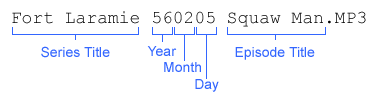
This episode from the series "Fort Laramie" was broadcast on February 5, 1956 with the episode title "Squaw Man"
Filenames of old time radio shows which are dated as yy-mm-dd. For example:
This episode from the series "Fort Laramie" was broadcast on February 5, 1956 with the episode title "Squaw Man"
Maisie Disc A001
|
Add Audio CD to Cart - $5.00 |
Maisie Disc A002
|
Add Audio CD to Cart - $5.00 |
Maisie Disc A003
|
Add Audio CD to Cart - $5.00 |
Maisie Disc A004
|
Add Audio CD to Cart - $5.00 |
Maisie Disc A005
|
Add Audio CD to Cart - $5.00 |
Maisie Disc A006
|
Add Audio CD to Cart - $5.00 |
Maisie Disc A007
|
Add Audio CD to Cart - $5.00 |
Maisie Disc A008
|
Add Audio CD to Cart - $5.00 |
Maisie Disc A009
|
Add Audio CD to Cart - $5.00 |
Maisie Disc A010
|
Add Audio CD to Cart - $5.00 |
Maisie Disc A011
|
Add Audio CD to Cart - $5.00 |
Maisie Disc A012
|
Add Audio CD to Cart - $5.00 |
Maisie Disc A013
|
Add Audio CD to Cart - $5.00 |
Maisie Disc A014
|
Add Audio CD to Cart - $5.00 |
Maisie Disc A015
|
Add Audio CD to Cart - $5.00 |
Maisie Disc A016
|
Add Audio CD to Cart - $5.00 |
Maisie Disc A017
|
Add Audio CD to Cart - $5.00 |
Maisie Disc A018
|
Add Audio CD to Cart - $5.00 |
Maisie Disc A019
|
Add Audio CD to Cart - $5.00 |
Maisie Disc A020
|
Add Audio CD to Cart - $5.00 |
Maisie Disc A021
|
Add Audio CD to Cart - $5.00 |
Maisie Disc A022
|
Add Audio CD to Cart - $5.00 |
Maisie Disc A023
|
Add Audio CD to Cart - $5.00 |
Maisie Disc A024
|
Add Audio CD to Cart - $5.00 |
Maisie Disc A025
|
Add Audio CD to Cart - $5.00 |
Maisie Disc A026
|
Add Audio CD to Cart - $5.00 |
Maisie Disc A027
|
Add Audio CD to Cart - $5.00 |
Maisie Disc A028
|
Add Audio CD to Cart - $5.00 |
Maisie Disc A029
|
Add Audio CD to Cart - $5.00 |
Maisie Disc A030
|
Add Audio CD to Cart - $5.00 |
Maisie Disc A031
|
Add Audio CD to Cart - $5.00 |
Maisie Disc A032
|
Add Audio CD to Cart - $5.00 |
Maisie Disc A033
|
Add Audio CD to Cart - $5.00 |
Maisie Disc A034
|
Add Audio CD to Cart - $5.00 |
Maisie Disc A035
|
Add Audio CD to Cart - $5.00 |
Maisie Disc A036
|
Add Audio CD to Cart - $5.00 |
Maisie Disc A037
|
Add Audio CD to Cart - $5.00 |
Maisie Disc A038
|
Add Audio CD to Cart - $5.00 |
Maisie Disc A039
|
Add Audio CD to Cart - $5.00 |
Maisie Disc A040
|
Add Audio CD to Cart - $5.00 |
Maisie Disc A041
|
Add Audio CD to Cart - $5.00 |
Maisie Disc A042
|
Add Audio CD to Cart - $5.00 |
Maisie Disc A043
|
Add Audio CD to Cart - $5.00 |
Please wait...
COMMENTS
Leo Verified Purchase
Leave a comment