
Senate War Investigation Committee tried millionaire Howard Hughes for a misuse of government funds to build an airplane nicknamed the "Spruce Goose."
2 old time radio show recordings
(total playtime 46 min)
available in the following formats:
1 MP3 CD
or
1 Audio CDs
Text on OTRCAT.com ©2001-2026 OTRCAT INC All Rights Reserved. Reproduction is prohibited.
Before there was Paul Allen, Bill Gates, Warren Buffett, or the Dot Com Millionaires, there was Howard Hughes.

Hughes showed a great mechanical aptitude from an early age, building the first radio transmitted in Houston at the age of 11. He was fascinated by aviation and became one of
In 1925, he moved to Hollywood to make a name for himself in the movie industry. He produced and directed several successful projects, as well as several miserable and embarrassing failures. The Hollywood years are noted for his being awarded the first Academy Award for director of a Comedy, Two Arabian Knights (1928) the flying epic, Hell's Angels (1930) and his liberal use of Jane Russell's assets in The Outlaw (1943) and The French Line (1954).
Aviation would be Hughes great love, and where he would make his greatest contributions. He developed some extremely radical concepts in aviation, often at considerable personal and financial risk. He survived a number of potentially fatal wrecks while testing aircraft, held several aviation records, and helped to develop airline travel for the general public. Two of his developments, which were made in support of the military, the

The H-4 flying boat had been the

On Nov 2, 1947, while conducting taxi tests in Los Angeles Harbor with Hughes at the control, the H-4 increased speed on the last test of the day, and became airborne for a little more than a mile.
The aircraft never flew again.
See also:
Text on OTRCAT.com ©2001-2026 OTRCAT INC All Rights Reserved. Reproduction is prohibited.
You have reached the maximum number of votes for a unregistered user.
Please login or create a new account to continue...
You have reached the maximum number to down votes in this page.
Filenames of old time radio shows which are dated as yy-mm-dd. For example:
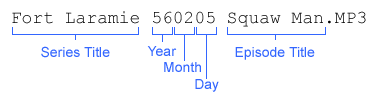
This episode from the series "Fort Laramie" was broadcast on February 5, 1956 with the episode title "Squaw Man"
Filenames of old time radio shows which are dated as yy-mm-dd. For example:
This episode from the series "Fort Laramie" was broadcast on February 5, 1956 with the episode title "Squaw Man"
Howard Hughes Hearings Disc A001
|
Add Audio CD to Cart - $5.00 |
Please wait...
COMMENTS
Be the first to comment on "Howard Hughes Hearings"
Leave a comment