
Creepy shows contrasting the innocent victims with the super evil villains find their home in the theater of the mind.
52 old time radio show recordings
(total playtime 24 hours, 14 min)
available in the following formats:
1 MP3 CD
or
26 Audio CDs
Text on OTRCAT.com ©2001-2026 OTRCAT INC All Rights Reserved. Reproduction is prohibited.

Gothic Horror has its roots with the Romantic Poets during the Enlightenment period at the beginning of the nineteenth century. Enlightenment philosophies influenced, among other things, the Founding Fathers of the United States, the beginnings of Feminism, and a decline of the influence of Religion. Curious and even fun from a modern perspective, the Enlightened Romantics would have been recognized as a threat to the old guard.
The terror that the monsters inspire works best in contrast to the innocence of the lovers, and Gothic Horror needs both to be successful. It is a formula that truly found a home in Radio's Theater of the Mind.

Successful Gothic Horror is usually driven by the imagination of a talented writer. Such is the case with Dark Fantasy. Oklahoma City writer Scott Bishop originally developed the series for WKY in 1941, and the series soon found a national audience over NBC. The stories may have seemed far-fetched, like the airplane flying, opera singing gorilla in "Spawn of Sub Human", but in actuality they were very well performed and produced. So well done that the radio network felt obligated only air the show well after bedtime for 1940s kids.

The villains of Gothic Horror are usually a personification on Evil. This means that everything is secondary to their nefarious and selfish schemes. In Carr's "Will you Make a Bet With Death" the tyrannical stepfather stumbles on to a plot to drive a young man insane and frame him for murder, all for the stepfather's own amusement.

The Strange Doctor Weird was an even creepier follow-up to Mutual's Mysterious Traveler.The Strange Doctor Weird had the same narrator, Maurice Tarplin, and sponsor, Adam Hats, and writer, Robert Arthur, as Traveler. Doctor Weird's villains were not always supernatural, like the desperate robbers in "The House Were Death Lives". There is plenty for them to fear, when they are locked up with their dead accomplices.
This creepy collection will send shivers up your spine and make you scream in terror as you root for the innocent victims and hide in terror from the scary villains.
See also: Darkness and Nighttime
Text on OTRCAT.com ©2001-2026 OTRCAT INC All Rights Reserved. Reproduction is prohibited.
You have reached the maximum number of votes for a unregistered user.
Please login or create a new account to continue...
You have reached the maximum number to down votes in this page.
Filenames of old time radio shows which are dated as yy-mm-dd. For example:
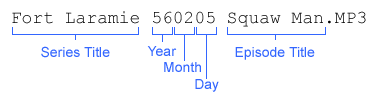
This episode from the series "Fort Laramie" was broadcast on February 5, 1956 with the episode title "Squaw Man"
Filenames of old time radio shows which are dated as yy-mm-dd. For example:
This episode from the series "Fort Laramie" was broadcast on February 5, 1956 with the episode title "Squaw Man"
Gothic Horror Disc A001
|
Add Audio CD to Cart - $5.00 |
Gothic Horror Disc A002
|
Add Audio CD to Cart - $5.00 |
Gothic Horror Disc A003
|
Add Audio CD to Cart - $5.00 |
Gothic Horror Disc A004
|
Add Audio CD to Cart - $5.00 |
Gothic Horror Disc A005
|
Add Audio CD to Cart - $5.00 |
Gothic Horror Disc A006
|
Add Audio CD to Cart - $5.00 |
Gothic Horror Disc A007
|
Add Audio CD to Cart - $5.00 |
Gothic Horror Disc A008
|
Add Audio CD to Cart - $5.00 |
Gothic Horror Disc A009
|
Add Audio CD to Cart - $5.00 |
Gothic Horror Disc A010
|
Add Audio CD to Cart - $5.00 |
Gothic Horror Disc A011
|
Add Audio CD to Cart - $5.00 |
Gothic Horror Disc A012
|
Add Audio CD to Cart - $5.00 |
Gothic Horror Disc A013
|
Add Audio CD to Cart - $5.00 |
Gothic Horror Disc A014
|
Add Audio CD to Cart - $5.00 |
Gothic Horror Disc A015
|
Add Audio CD to Cart - $5.00 |
Gothic Horror Disc A016
|
Add Audio CD to Cart - $5.00 |
Gothic Horror Disc A017
|
Add Audio CD to Cart - $5.00 |
Gothic Horror Disc A018
|
Add Audio CD to Cart - $5.00 |
Gothic Horror Disc A019
|
Add Audio CD to Cart - $5.00 |
Gothic Horror Disc A020
|
Add Audio CD to Cart - $5.00 |
Gothic Horror Disc A021
|
Add Audio CD to Cart - $5.00 |
Gothic Horror Disc A022
|
Add Audio CD to Cart - $5.00 |
Gothic Horror Disc A023
|
Add Audio CD to Cart - $5.00 |
Gothic Horror Disc A024
|
Add Audio CD to Cart - $5.00 |
Gothic Horror Disc A025
|
Add Audio CD to Cart - $5.00 |
Gothic Horror Disc A026
|
Add Audio CD to Cart - $5.00 |
Please wait...
COMMENTS
Eric Verified Purchase
Dan Verified Purchase
Leave a comment