
Crooner Rudy Vallee became one of the earliest mass-media pop stars in this 1930's comedy variety old time radio show. Rivaled in popularity by only Amos & Andy,The Royal Gelatin Hour broadcast introduced writers and comedians (including Edgar Bergen) to the world via radio.
50 old time radio show recordings
(total playtime 45 hours, 33 min)
available in the following formats:
2 MP3 CDs
or
50 Audio CDs
Text on OTRCAT.com ©2001-2026 OTRCAT INC All Rights Reserved. Reproduction is prohibited.


Vallee became the first of what would be known as "crooners". The crooner's soft voice was perfect for the new medium of radio, and Vallee's trombone-like phrasing and vocal style would become an inspiration to later artists like Bing Crosby, Frank Sinatra, Dean Martin, and Perry Como.
As a crooner Rudy Vallee became one of the earliest mass-media pop stars. He was mobbed by screaming girls where ever he performed. In venues that did not have electric microphones and amplification, the crowd couldn't hear him they would swoon just to get a glimpse of his lips through his megaphone.
The head of programming at NBC, Bertha Brainard, was the network's first female executive. In the late 20's she began pushing for a new type of program, the Variety Show, and she insisted on having Rudy Vallee as the host. "Only a woman" she would explain "could understand the appeal" of Vallee's voice.
The show was sponsored by Standard Brands, which J.P. Morgan had formed by merging the Fleischmann Yeast Co, Royal Baking Powder, Chase and Sanborn Coffee, and others. Originally titled The Fleischmann's Yeast Hour, the show was only rivaled in popularity by Amos and Andy.

As The Royal Gelatin Hour the program began to feature guests from the Motion Picture World, including writer Noel Coward, Fay Wray, Tyrone Power, Bob Hope, Roland Young, Gertrude Lawrence, Fanny Brice, and Ed Wynn. During the first season of The Royal Gelatin Hour Vallee introduced a young ventriloquist, Edgar Bergen. Although even Vallee expressed doubts at having a ventriloquist on the radio, Bergen's comedic timing and style, with the precociousness of his "sidekick" Charlie McCarthy, made him a hit. Bergen appeared on several more episodes during the 36 season, and in 1937 Standard Brands rebuilt The Chase and Sanborn Hour around Bergen and McCarthy, running until 1949.
The Royal Gelatin Hour also made history during Rudy Vallee's 1937 summer vacation. Vallee insisted that the sponsor hire jazz great Louis Armstrong as summer host, making Armstrong the first African American to host a major network program.
Text on OTRCAT.com ©2001-2026 OTRCAT INC All Rights Reserved. Reproduction is prohibited.
You have reached the maximum number of votes for a unregistered user.
Please login or create a new account to continue...
You have reached the maximum number to down votes in this page.
Filenames of old time radio shows which are dated as yy-mm-dd. For example:
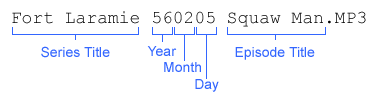
This episode from the series "Fort Laramie" was broadcast on February 5, 1956 with the episode title "Squaw Man"
Filenames of old time radio shows which are dated as yy-mm-dd. For example:
This episode from the series "Fort Laramie" was broadcast on February 5, 1956 with the episode title "Squaw Man"
Royal Gelatin Hour Disc A001
|
Add Audio CD to Cart - $5.00 |
Royal Gelatin Hour Disc A002
|
Add Audio CD to Cart - $5.00 |
Royal Gelatin Hour Disc A003
|
Add Audio CD to Cart - $5.00 |
Royal Gelatin Hour Disc A004
|
Add Audio CD to Cart - $5.00 |
Royal Gelatin Hour Disc A005
|
Add Audio CD to Cart - $5.00 |
Royal Gelatin Hour Disc A006
|
Add Audio CD to Cart - $5.00 |
Royal Gelatin Hour Disc A007
|
Add Audio CD to Cart - $5.00 |
Royal Gelatin Hour Disc A008
|
Add Audio CD to Cart - $5.00 |
Royal Gelatin Hour Disc A009
|
Add Audio CD to Cart - $5.00 |
Royal Gelatin Hour Disc A010
|
Add Audio CD to Cart - $5.00 |
Royal Gelatin Hour Disc A011
|
Add Audio CD to Cart - $5.00 |
Royal Gelatin Hour Disc A012
|
Add Audio CD to Cart - $5.00 |
Royal Gelatin Hour Disc A013
|
Add Audio CD to Cart - $5.00 |
Royal Gelatin Hour Disc A014
|
Add Audio CD to Cart - $5.00 |
Royal Gelatin Hour Disc A015
|
Add Audio CD to Cart - $5.00 |
Royal Gelatin Hour Disc A016
|
Add Audio CD to Cart - $5.00 |
Royal Gelatin Hour Disc A017
|
Add Audio CD to Cart - $5.00 |
Royal Gelatin Hour Disc A018
|
Add Audio CD to Cart - $5.00 |
Royal Gelatin Hour Disc A019
|
Add Audio CD to Cart - $5.00 |
Royal Gelatin Hour Disc A020
|
Add Audio CD to Cart - $5.00 |
Royal Gelatin Hour Disc A021
|
Add Audio CD to Cart - $5.00 |
Royal Gelatin Hour Disc A022
|
Add Audio CD to Cart - $5.00 |
Royal Gelatin Hour Disc A023
|
Add Audio CD to Cart - $5.00 |
Royal Gelatin Hour Disc A024
|
Add Audio CD to Cart - $5.00 |
Royal Gelatin Hour Disc A025
|
Add Audio CD to Cart - $5.00 |
Royal Gelatin Hour Disc A026
|
Add Audio CD to Cart - $5.00 |
Royal Gelatin Hour Disc A027
|
Add Audio CD to Cart - $5.00 |
Royal Gelatin Hour Disc A028
|
Add Audio CD to Cart - $5.00 |
Royal Gelatin Hour Disc A029
|
Add Audio CD to Cart - $5.00 |
Royal Gelatin Hour Disc A030
|
Add Audio CD to Cart - $5.00 |
Royal Gelatin Hour Disc A031
|
Add Audio CD to Cart - $5.00 |
Royal Gelatin Hour Disc A032
|
Add Audio CD to Cart - $5.00 |
Royal Gelatin Hour Disc A033
|
Add Audio CD to Cart - $5.00 |
Royal Gelatin Hour Disc A034
|
Add Audio CD to Cart - $5.00 |
Royal Gelatin Hour Disc A035
|
Add Audio CD to Cart - $5.00 |
Royal Gelatin Hour Disc A036
|
Add Audio CD to Cart - $5.00 |
Royal Gelatin Hour Disc A037
|
Add Audio CD to Cart - $5.00 |
Royal Gelatin Hour Disc A038
|
Add Audio CD to Cart - $5.00 |
Royal Gelatin Hour Disc A039
|
Add Audio CD to Cart - $5.00 |
Royal Gelatin Hour Disc A040
|
Add Audio CD to Cart - $5.00 |
Royal Gelatin Hour Disc A041
|
Add Audio CD to Cart - $5.00 |
Royal Gelatin Hour Disc A042
|
Add Audio CD to Cart - $5.00 |
Royal Gelatin Hour Disc A043
|
Add Audio CD to Cart - $5.00 |
Royal Gelatin Hour Disc A044
|
Add Audio CD to Cart - $5.00 |
Royal Gelatin Hour Disc A045
|
Add Audio CD to Cart - $5.00 |
Royal Gelatin Hour Disc A046
|
Add Audio CD to Cart - $5.00 |
Royal Gelatin Hour Disc A047
|
Add Audio CD to Cart - $5.00 |
Royal Gelatin Hour Disc A048
|
Add Audio CD to Cart - $5.00 |
Royal Gelatin Hour Disc A049
|
Add Audio CD to Cart - $5.00 |
Royal Gelatin Hour Disc A050
|
Add Audio CD to Cart - $5.00 |
Please wait...
COMMENTS
Be the first to comment on "Royal Gelatin Hour"
Leave a comment