
Combine one of radio's most creative writers with the talents of a single actor and a late night time slot, and you have the ingredients for the deliciously creepy Quiet, Please.
91 old time radio show recordings
(total playtime 42 hours, 17 min)
available in the following formats:
2 MP3 CDs
or
45 Audio CDs
Text on OTRCAT.com ©2001-2026 OTRCAT INC All Rights Reserved. Reproduction is prohibited.
Outstanding Dark Fantasy (1947 - 49)
Quiet, Please is usually listed as a horror and suspense program, but the topics would also range through romance, science fiction, crime and family drama, even humor, albeit dark and self deprecating. The call for Quiet, Please asks the listener to put away distractions so that another world can be entered, and then (hopefully) safely left behind. "And so, until next week at this same time, I am quietly yours, Ernest Chappell."

Quiet, Please,repeated twice, followed by a lonely, funereal organ playing. Most of the story is told as a narrative, with little dialog. The featured actor, Ernest Chappell, is credited as "the man who spoke to you." Chappell did not play an action character; rather he would tell the listener a story, usually in the form of a flashback. He would be a retired oil man telling a story to the listener from his living room, or an old railroad worker whom the listener meets in the station. Always the listener is engaged because the story is being told directly to him, as though he were in the same room. Slowly, quietly, the listener is drawn into a world very similar to our own, but it is a world where an unseen, unknown terror is lurking very nearby. Chappell would usually portray a specialist of some type, an oil platform worker, a mountain climber, a soldier, a telegraph operator, and Cooper would pepper the stories with details of the job, further drawing the listener into the world they create.
Ernest Chappell had worked in radio for a number of years, but always as a newsman or announcer. This suited Cooper's project perfectly (acting was a "pet hate" of Cooper's). The stories are genius in their simplicity, mostly narrative with only two or three actors besides Chappell filling small parts, and very little sound effects and other production techniques besides the afore mentioned organ. The show was also noted for its long, dramatic pauses. One reviewer said they were often long enough that you thought your radio had gone dead, that a "half hour Cooper script played at ordinary tempo would run about 11 minutes." The same reviewer would praise the show.
(Please note that many of the rare recordings in this collection may be of inferior sound quality.)
Text on OTRCAT.com ©2001-2026 OTRCAT INC All Rights Reserved. Reproduction is prohibited.
You have reached the maximum number of votes for a unregistered user.
Please login or create a new account to continue...
You have reached the maximum number to down votes in this page.
Filenames of old time radio shows which are dated as yy-mm-dd. For example:
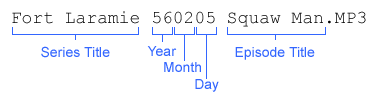
This episode from the series "Fort Laramie" was broadcast on February 5, 1956 with the episode title "Squaw Man"
Filenames of old time radio shows which are dated as yy-mm-dd. For example:
This episode from the series "Fort Laramie" was broadcast on February 5, 1956 with the episode title "Squaw Man"
Quiet Please Disc A001
|
Add Audio CD to Cart - $5.00 |
Quiet Please Disc A002
|
Add Audio CD to Cart - $5.00 |
Quiet Please Disc A003
|
Add Audio CD to Cart - $5.00 |
Quiet Please Disc A004
|
Add Audio CD to Cart - $5.00 |
Quiet Please Disc A005
|
Add Audio CD to Cart - $5.00 |
Quiet Please Disc A006
|
Add Audio CD to Cart - $5.00 |
Quiet Please Disc A007
|
Add Audio CD to Cart - $5.00 |
Quiet Please Disc A008
|
Add Audio CD to Cart - $5.00 |
Quiet Please Disc A009
|
Add Audio CD to Cart - $5.00 |
Quiet Please Disc A010
|
Add Audio CD to Cart - $5.00 |
Quiet Please Disc A011
|
Add Audio CD to Cart - $5.00 |
Quiet Please Disc A012
|
Add Audio CD to Cart - $5.00 |
Quiet Please Disc A013
|
Add Audio CD to Cart - $5.00 |
Quiet Please Disc A014
|
Add Audio CD to Cart - $5.00 |
Quiet Please Disc A015
|
Add Audio CD to Cart - $5.00 |
Quiet Please Disc A016
|
Add Audio CD to Cart - $5.00 |
Quiet Please Disc A017
|
Add Audio CD to Cart - $5.00 |
Quiet Please Disc A018
|
Add Audio CD to Cart - $5.00 |
Quiet Please Disc A019
|
Add Audio CD to Cart - $5.00 |
Quiet Please Disc A020
|
Add Audio CD to Cart - $5.00 |
Quiet Please Disc A021
|
Add Audio CD to Cart - $5.00 |
Quiet Please Disc A022
|
Add Audio CD to Cart - $5.00 |
Quiet Please Disc A023
|
Add Audio CD to Cart - $5.00 |
Quiet Please Disc A024
|
Add Audio CD to Cart - $5.00 |
Quiet Please Disc A025
|
Add Audio CD to Cart - $5.00 |
Quiet Please Disc A026
|
Add Audio CD to Cart - $5.00 |
Quiet Please Disc A027
|
Add Audio CD to Cart - $5.00 |
Quiet Please Disc A028
|
Add Audio CD to Cart - $5.00 |
Quiet Please Disc A029
|
Add Audio CD to Cart - $5.00 |
Quiet Please Disc A030
|
Add Audio CD to Cart - $5.00 |
Quiet Please Disc A031
|
Add Audio CD to Cart - $5.00 |
Quiet Please Disc A032
|
Add Audio CD to Cart - $5.00 |
Quiet Please Disc A033
|
Add Audio CD to Cart - $5.00 |
Quiet Please Disc A034
|
Add Audio CD to Cart - $5.00 |
Quiet Please Disc A035
|
Add Audio CD to Cart - $5.00 |
Quiet Please Disc A036
|
Add Audio CD to Cart - $5.00 |
Quiet Please Disc A037
|
Add Audio CD to Cart - $5.00 |
Quiet Please Disc A038
|
Add Audio CD to Cart - $5.00 |
Quiet Please Disc A039
|
Add Audio CD to Cart - $5.00 |
Quiet Please Disc A040
|
Add Audio CD to Cart - $5.00 |
Quiet Please Disc A041
|
Add Audio CD to Cart - $5.00 |
Quiet Please Disc A042
|
Add Audio CD to Cart - $5.00 |
Quiet Please Disc A043
|
Add Audio CD to Cart - $5.00 |
Quiet Please Disc A044
|
Add Audio CD to Cart - $5.00 |
Quiet Please Disc A045
|
Add Audio CD to Cart - $5.00 |
Please wait...

COMMENTS
John Verified Purchase
Amelie
William Verified Purchase
James Verified Purchase
Joe Verified Purchase
Leave a comment