
This compilation has some of Jack Benny's best running gags and first appearances by his stellar comedy cast.
161 old time radio show recordings
(total playtime 77 hours, 59 min)
available in the following formats:
4 MP3 CDs
or
82 Audio CDs
Text on OTRCAT.com ©2001-2026 OTRCAT INC All Rights Reserved. Reproduction is prohibited.

This collection contains the "best of" episodes from the extensive Jack Benny Collection.
A staple of comedy shows is the running gag. The most successful running gags become a kind of inside joke shared between the performers and the audience.

The real humor of the Jack Benny Program was Jack Benny's Program was Jack's character. Jack Benny on the radio was everything that Jack Benny was not. On the radio Jack was a vain, miserly bachelor wrapped in his own neurosis. In real life Jack was a very happy man, madly in love with his wife, and generous to a fault. Most of the laughs on his program came when he allowed his supporting players to get the laughs at his expense, and Jack had a great cast of supporting characters to work with.
Following vaudeville tradition, the first thing Jack did when he got married was to write his wife into the act. On the program Mary Livingstone was a smart-aleck friend, but not quite a girl friend, which allowed Jack to try to date celebrities like Barbara Stanwyck. One recurring bit of Mary's was similar to Portland Hoffa's "Oh Mister Allen!" routines. When Mary first appeared she would read a letter from her mother in Plainfield, NJ. Mother usually had news about Mary's fictional sister, Babe. Mary did have a sister named Babe, 
Don Wilson was the announcer for the program, and often was the butt of Jack's jokes, usually about his weight. Band leader Phil Harris began his run with the show as a "jazz talking hep cat" with more than a few wise cracks for his boss. Jack often chided Phil for his fast life style, but Phil would wind up leaving the program to start a family show with his real-life bride, Alice Faye. In 1952 the band leader duties were taken over by Bing's kid brother, Bob Crosby.
One of the most popular recurring characters was Jack's butler and valet, Rochester. Eddie Anderson first appeared as a railroad Redcap and porter and later as a waiter. He made himself "At home" with the cast, joining in with the Jello jingle. The show received enough positive mail on Anderson's appearances that he was written in as Rochester, becoming the first African-American to have a recurring role on a radio program. Benny and Anderson have both taken criticism for Rochester perpetuating racial stereo-types. However it should be noted Rochester, even though he was a servant, was always treated as an equal by Benny both on and off the air.

The violin was the root of Benny and Fred Allen's famous "Feud". The feud was of course a put-on that began when Fred compared Benny's playing with a genius violinist appearing on his program. The remark was an ad-lib, but Benny thought it was incredibly funny and had his writers work it into the show. In addition to the violin feud, the Benny program used "Did you hear what Fred Allen said?" a number of times. What made the bits even funnier was the fact that Allen and Benny were close friends in real life.


Jack Benny began his radio career in 1932, and worked full time until 1965, when he ended his regular TV series. Although he made a some appearances as a guest star and specials on his own afterward, he basically got out of the game on top. He shared an ambivalence towards TV with Fred Allen, Jack stated "The camera was a man-eating monster... It gave a performer close-up exposure that, week after week, threatened his existence as an interesting entertainer."
Jack Benny was certainly always interesting and always entertaining.
See also:

Text on OTRCAT.com ©2001-2026 OTRCAT INC All Rights Reserved. Reproduction is prohibited.
You have reached the maximum number of votes for a unregistered user.
Please login or create a new account to continue...
You have reached the maximum number to down votes in this page.
Filenames of old time radio shows which are dated as yy-mm-dd. For example:
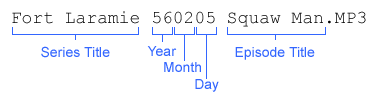
This episode from the series "Fort Laramie" was broadcast on February 5, 1956 with the episode title "Squaw Man"
Filenames of old time radio shows which are dated as yy-mm-dd. For example:
This episode from the series "Fort Laramie" was broadcast on February 5, 1956 with the episode title "Squaw Man"
Jack Benny Gags Disc A001
|
Add Audio CD to Cart - $5.00 |
Jack Benny Gags Disc A002
|
Add Audio CD to Cart - $5.00 |
Jack Benny Gags Disc A003
|
Add Audio CD to Cart - $5.00 |
Jack Benny Gags Disc A004
|
Add Audio CD to Cart - $5.00 |
Jack Benny Gags Disc A005
|
Add Audio CD to Cart - $5.00 |
Jack Benny Gags Disc A006
|
Add Audio CD to Cart - $5.00 |
Jack Benny Gags Disc A007
|
Add Audio CD to Cart - $5.00 |
Jack Benny Gags Disc A008
|
Add Audio CD to Cart - $5.00 |
Jack Benny Gags Disc A009
|
Add Audio CD to Cart - $5.00 |
Jack Benny Gags Disc A010
|
Add Audio CD to Cart - $5.00 |
Jack Benny Gags Disc A011
|
Add Audio CD to Cart - $5.00 |
Jack Benny Gags Disc A012
|
Add Audio CD to Cart - $5.00 |
Jack Benny Gags Disc A013
|
Add Audio CD to Cart - $5.00 |
Jack Benny Gags Disc A014
|
Add Audio CD to Cart - $5.00 |
Jack Benny Gags Disc A015
|
Add Audio CD to Cart - $5.00 |
Jack Benny Gags Disc A016
|
Add Audio CD to Cart - $5.00 |
Jack Benny Gags Disc A017
|
Add Audio CD to Cart - $5.00 |
Jack Benny Gags Disc A018
|
Add Audio CD to Cart - $5.00 |
Jack Benny Gags Disc A019
|
Add Audio CD to Cart - $5.00 |
Jack Benny Gags Disc A020
|
Add Audio CD to Cart - $5.00 |
Jack Benny Gags Disc A021
|
Add Audio CD to Cart - $5.00 |
Jack Benny Gags Disc A022
|
Add Audio CD to Cart - $5.00 |
Jack Benny Gags Disc A023
|
Add Audio CD to Cart - $5.00 |
Jack Benny Gags Disc A024
|
Add Audio CD to Cart - $5.00 |
Jack Benny Gags Disc A025
|
Add Audio CD to Cart - $5.00 |
Jack Benny Gags Disc A026
|
Add Audio CD to Cart - $5.00 |
Jack Benny Gags Disc A027
|
Add Audio CD to Cart - $5.00 |
Jack Benny Gags Disc A028
|
Add Audio CD to Cart - $5.00 |
Jack Benny Gags Disc A029
|
Add Audio CD to Cart - $5.00 |
Jack Benny Gags Disc A030
|
Add Audio CD to Cart - $5.00 |
Jack Benny Gags Disc A031
|
Add Audio CD to Cart - $5.00 |
Jack Benny Gags Disc A032
|
Add Audio CD to Cart - $5.00 |
Jack Benny Gags Disc A033
|
Add Audio CD to Cart - $5.00 |
Jack Benny Gags Disc A034
|
Add Audio CD to Cart - $5.00 |
Jack Benny Gags Disc A035
|
Add Audio CD to Cart - $5.00 |
Jack Benny Gags Disc A036
|
Add Audio CD to Cart - $5.00 |
Jack Benny Gags Disc A037
|
Add Audio CD to Cart - $5.00 |
Jack Benny Gags Disc A038
|
Add Audio CD to Cart - $5.00 |
Jack Benny Gags Disc A039
|
Add Audio CD to Cart - $5.00 |
Jack Benny Gags Disc A040
|
Add Audio CD to Cart - $5.00 |
Jack Benny Gags Disc A041
|
Add Audio CD to Cart - $5.00 |
Jack Benny Gags Disc A042
|
Add Audio CD to Cart - $5.00 |
Jack Benny Gags Disc A043
|
Add Audio CD to Cart - $5.00 |
Jack Benny Gags Disc A044
|
Add Audio CD to Cart - $5.00 |
Jack Benny Gags Disc A045
|
Add Audio CD to Cart - $5.00 |
Jack Benny Gags Disc A046
|
Add Audio CD to Cart - $5.00 |
Jack Benny Gags Disc A047
|
Add Audio CD to Cart - $5.00 |
Jack Benny Gags Disc A048
|
Add Audio CD to Cart - $5.00 |
Jack Benny Gags Disc A049
|
Add Audio CD to Cart - $5.00 |
Jack Benny Gags Disc A050
|
Add Audio CD to Cart - $5.00 |
Jack Benny Gags Disc A051
|
Add Audio CD to Cart - $5.00 |
Jack Benny Gags Disc A052
|
Add Audio CD to Cart - $5.00 |
Jack Benny Gags Disc A053
|
Add Audio CD to Cart - $5.00 |
Jack Benny Gags Disc A054
|
Add Audio CD to Cart - $5.00 |
Jack Benny Gags Disc A055
|
Add Audio CD to Cart - $5.00 |
Jack Benny Gags Disc A056
|
Add Audio CD to Cart - $5.00 |
Jack Benny Gags Disc A057
|
Add Audio CD to Cart - $5.00 |
Jack Benny Gags Disc A058
|
Add Audio CD to Cart - $5.00 |
Jack Benny Gags Disc A059
|
Add Audio CD to Cart - $5.00 |
Jack Benny Gags Disc A060
|
Add Audio CD to Cart - $5.00 |
Jack Benny Gags Disc A061
|
Add Audio CD to Cart - $5.00 |
Jack Benny Gags Disc A062
|
Add Audio CD to Cart - $5.00 |
Jack Benny Gags Disc A063
|
Add Audio CD to Cart - $5.00 |
Jack Benny Gags Disc A064
|
Add Audio CD to Cart - $5.00 |
Jack Benny Gags Disc A065
|
Add Audio CD to Cart - $5.00 |
Jack Benny Gags Disc A066
|
Add Audio CD to Cart - $5.00 |
Jack Benny Gags Disc A067
|
Add Audio CD to Cart - $5.00 |
Jack Benny Gags Disc A068
|
Add Audio CD to Cart - $5.00 |
Jack Benny Gags Disc A069
|
Add Audio CD to Cart - $5.00 |
Jack Benny Gags Disc A070
|
Add Audio CD to Cart - $5.00 |
Jack Benny Gags Disc A071
|
Add Audio CD to Cart - $5.00 |
Jack Benny Gags Disc A072
|
Add Audio CD to Cart - $5.00 |
Jack Benny Gags Disc A073
|
Add Audio CD to Cart - $5.00 |
Jack Benny Gags Disc A074
|
Add Audio CD to Cart - $5.00 |
Jack Benny Gags Disc A075
|
Add Audio CD to Cart - $5.00 |
Jack Benny Gags Disc A076
|
Add Audio CD to Cart - $5.00 |
Jack Benny Gags Disc A077
|
Add Audio CD to Cart - $5.00 |
Jack Benny Gags Disc A078
|
Add Audio CD to Cart - $5.00 |
Jack Benny Gags Disc A079
|
Add Audio CD to Cart - $5.00 |
Jack Benny Gags Disc A080
|
Add Audio CD to Cart - $5.00 |
Jack Benny Gags Disc A081
|
Add Audio CD to Cart - $5.00 |
Jack Benny Gags Disc A082
|
Add Audio CD to Cart - $5.00 |
Please wait...
COMMENTS
Diane Verified Purchase
Joe Verified Purchase
Ryan Verified Purchase
Eric Verified Purchase
Jim Verified Purchase
Eric Verified Purchase
Donblakeinsantafe@Gmail.Com Verified Purchase
Leave a comment