
Godfrey's conversational style made his show seem like a friend talking to listeners directly.
103 old time radio show recordings
(total playtime 51 hours, 17 min)
available in the following formats:
3 MP3 CDs
or
55 Audio CDs
Text on OTRCAT.com ©2001-2026 OTRCAT INC All Rights Reserved. Reproduction is prohibited.
Arthur Godfrey
(1903 – 1983)

We all can agree that things are better said straight than garbling up the truth. Arthur Godfrey felt the same way. Arthur grew up in the early parts of the 20th century, where radio waves were the staging grounds for advertising companies to wage their "wars." It was probably Arthur's youth that help him look beyond the "war" and talk directly to people that these advertising companies where dehumanizing.
Arthur Godfrey was born in the "School of Hard-Knocks," in New York City, in 1903. Not a very bright child, even all the way up to his death in 1983, Arthur learned all his "skills" on the hard streets of the Big Apple. In 1921, Godfrey joined the Navy and worked as a radio operator when on sea duty. It was at sea where he learned how to play his famous instruments that identified him throughout his career, the Ukulele and the Banjo. After his duty was up in the Navy, Arthur went off to live in Detroit, where he got a job selling cemetery lots. It was here that Arthur noticed that he was good at selling things (he must have been really good at selling lots if he could sell to a bunch of sad family members who were looking to bury their loved ones)!

After a brief stint as a cab driver, Arthur joined the service, AGAIN, but this time, in the Coast Guard. One day, when he and his fellow guardsmen were listening to a Radio amateur hour show on WFBR, Arthur said, 'I can do that!" After showing up at the radio station with his buddies, the manager of the show squeezed them into a time slot on the show. After their performance, the manager decided to keep them on for future shows. This served as a launching pad for Arthur's career.

Here, he would have regular talents, "non-stars" he would call them, come on to the show and showcase their talent for the audience. At the end of the show, the audience and Arthur would serve as the judges. If they liked any of the talents, they would ask them to come back to the next show and compete against the next influx of talent. If that same talent kept on winning, then they were invited to join the show's band, nicknamed the "Little Godfreys." It was from here that the McGuire Sisters and the Chordettes originated from.
After many successful seasons, the Network decided to build a mini-studio inside Arthur's 800-acre farm in upstate Virginia, mainly to convey a sense of reality to the audience. From here, Arthur would do his shows, while Arthur chatted with the rest of his cast who were stationed all over the country, usually doing so while eating his breakfast and reading the daily newspaper. This was the format of the show until its run was ended in 1972, by Arthur Godfrey himself.
For more talent scount excitement, see also: Major Bowes and Talent Show Collection.

Text on OTRCAT.com ©2001-2026 OTRCAT INC All Rights Reserved. Reproduction is prohibited.
You have reached the maximum number of votes for a unregistered user.
Please login or create a new account to continue...
You have reached the maximum number to down votes in this page.
Filenames of old time radio shows which are dated as yy-mm-dd. For example:
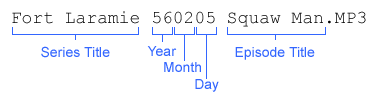
This episode from the series "Fort Laramie" was broadcast on February 5, 1956 with the episode title "Squaw Man"
Filenames of old time radio shows which are dated as yy-mm-dd. For example:
This episode from the series "Fort Laramie" was broadcast on February 5, 1956 with the episode title "Squaw Man"
Arthur Godfrey Disc A001
|
Add Audio CD to Cart - $5.00 |
Arthur Godfrey Disc A002
|
Add Audio CD to Cart - $5.00 |
Arthur Godfrey Disc A003
|
Add Audio CD to Cart - $5.00 |
Arthur Godfrey Disc A004
|
Add Audio CD to Cart - $5.00 |
Arthur Godfrey Disc A005
|
Add Audio CD to Cart - $5.00 |
Arthur Godfrey Disc A006
|
Add Audio CD to Cart - $5.00 |
Arthur Godfrey Disc A007
|
Add Audio CD to Cart - $5.00 |
Arthur Godfrey Disc A008
|
Add Audio CD to Cart - $5.00 |
Arthur Godfrey Disc A009
|
Add Audio CD to Cart - $5.00 |
Arthur Godfrey Disc A010
|
Add Audio CD to Cart - $5.00 |
Arthur Godfrey Disc A011
|
Add Audio CD to Cart - $5.00 |
Arthur Godfrey Disc A012
|
Add Audio CD to Cart - $5.00 |
Arthur Godfrey Disc A013
|
Add Audio CD to Cart - $5.00 |
Arthur Godfrey Disc A014
|
Add Audio CD to Cart - $5.00 |
Arthur Godfrey Disc A015
|
Add Audio CD to Cart - $5.00 |
Arthur Godfrey Disc A016
|
Add Audio CD to Cart - $5.00 |
Arthur Godfrey Disc A017
|
Add Audio CD to Cart - $5.00 |
Arthur Godfrey Disc A018
|
Add Audio CD to Cart - $5.00 |
Arthur Godfrey Disc A019
|
Add Audio CD to Cart - $5.00 |
Arthur Godfrey Disc A020
|
Add Audio CD to Cart - $5.00 |
Arthur Godfrey Disc A021
|
Add Audio CD to Cart - $5.00 |
Arthur Godfrey Disc A022
|
Add Audio CD to Cart - $5.00 |
Arthur Godfrey Disc A023
|
Add Audio CD to Cart - $5.00 |
Arthur Godfrey Disc A024
|
Add Audio CD to Cart - $5.00 |
Arthur Godfrey Disc A025
|
Add Audio CD to Cart - $5.00 |
Arthur Godfrey Disc A026
|
Add Audio CD to Cart - $5.00 |
Arthur Godfrey Disc A027
|
Add Audio CD to Cart - $5.00 |
Arthur Godfrey Disc A028
|
Add Audio CD to Cart - $5.00 |
Arthur Godfrey Disc A029
|
Add Audio CD to Cart - $5.00 |
Arthur Godfrey Disc A030
|
Add Audio CD to Cart - $5.00 |
Arthur Godfrey Disc A031
|
Add Audio CD to Cart - $5.00 |
Arthur Godfrey Disc A032
|
Add Audio CD to Cart - $5.00 |
Arthur Godfrey Disc A033
|
Add Audio CD to Cart - $5.00 |
Arthur Godfrey Disc A034
|
Add Audio CD to Cart - $5.00 |
Arthur Godfrey Disc A035
|
Add Audio CD to Cart - $5.00 |
Arthur Godfrey Disc A036
|
Add Audio CD to Cart - $5.00 |
Arthur Godfrey Disc A037
|
Add Audio CD to Cart - $5.00 |
Arthur Godfrey Disc A038
|
Add Audio CD to Cart - $5.00 |
Arthur Godfrey Disc A039
|
Add Audio CD to Cart - $5.00 |
Arthur Godfrey Disc A040
|
Add Audio CD to Cart - $5.00 |
Arthur Godfrey Disc A041
|
Add Audio CD to Cart - $5.00 |
Arthur Godfrey Disc A042
|
Add Audio CD to Cart - $5.00 |
Arthur Godfrey Disc A043
|
Add Audio CD to Cart - $5.00 |
Arthur Godfrey Disc A044
|
Add Audio CD to Cart - $5.00 |
Arthur Godfrey Disc A045
|
Add Audio CD to Cart - $5.00 |
Arthur Godfrey Disc A046
|
Add Audio CD to Cart - $5.00 |
Arthur Godfrey Disc A047
|
Add Audio CD to Cart - $5.00 |
Arthur Godfrey Disc A048
|
Add Audio CD to Cart - $5.00 |
Arthur Godfrey Disc A049
|
Add Audio CD to Cart - $5.00 |
Arthur Godfrey Disc A050
|
Add Audio CD to Cart - $5.00 |
Arthur Godfrey Disc A051
|
Add Audio CD to Cart - $5.00 |
Arthur Godfrey Disc A052
|
Add Audio CD to Cart - $5.00 |
Arthur Godfrey Disc A053
|
Add Audio CD to Cart - $5.00 |
Arthur Godfrey Disc A054
|
Add Audio CD to Cart - $5.00 |
Arthur Godfrey Disc A055
|
Add Audio CD to Cart - $5.00 |
Please wait...

COMMENTS
Ed Verified Purchase
Chris Verified Purchase
Jimmie Verified Purchase
Andy Verified Purchase
Carl Verified Purchase
Leave a comment