
Pleasant daytime music and conversation from two of show biz's greatest talents.
222 old time radio show recordings
(total playtime 70 hours, 53 min)
available in the following formats:
4 MP3 CDs
or
73 Audio CDs
Text on OTRCAT.com ©2001-2026 OTRCAT INC All Rights Reserved. Reproduction is prohibited.

(1960 - 62)

One of Crosby's most popular numbers was "White Christmas", written by Irving Berlin. Berlin introduced Bing to the number for the 1942 film "Holiday Inn". The song, with its nostalgic images of a Christmas at home, pulled at the hearts of a Nation at War (the 1942 hit had to be rerecorded in 1947--the original master disk had become damaged from repeated repressings of the single) and became the inspiration for the 1954 film White Christmas. During filming Bing became a lifelong friend to his co-star, Rosemary Clooney.
Clooney began singing professionally with her younger sister after their father took all the household money to celebrate VE Day and never returned. Although the sisters had success together, Betty Clooney recognized that she was holding her more talented older sister back, and left the act. Rosemary made recordings for Columbia records with Tony Pastor's band, but her personal success began with a Mitch Miller arranged novelty hit "Come On-a My House", a song Rosemary didn't particularly care for.

Crosby had long seen the advantages of prerecording his radio performances. It would allow the artist to concentrate on delivering a perfect performance while scrapping the bad takes. Detractors claimed it was so that Bing could dedicate more time to his golf game. The networks insisted that audiences preferred the intimacy of a live performance, but where eventually won over after Crosby had success with an ABC show sponsored by Philco in 1947. Crosby also invested personally in Ampex reel-to-reel magnetic tape recording equipment.
This taping equipment made the Crosby Clooney Show possible. Each of the artists had a large number of songs recorded, and recorded a number of duets as well. The spoken parts of the program were recorded when the actors could get together in what became friendly sessions when it was convenient to do so. Some takes were interrupted when Rosemary's kids ran in and out from the pool at their house.
Clooney's life and career took a downturn soon after the Crosby-Clooney Show. Her eventual recovery from the depths of depression and addiction were due in a large part to the friendship of Bing Crosby.
See also:
Text on OTRCAT.com ©2001-2026 OTRCAT INC All Rights Reserved. Reproduction is prohibited.
You have reached the maximum number of votes for a unregistered user.
Please login or create a new account to continue...
You have reached the maximum number to down votes in this page.
Filenames of old time radio shows which are dated as yy-mm-dd. For example:
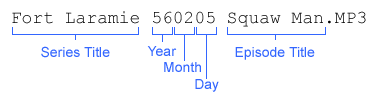
This episode from the series "Fort Laramie" was broadcast on February 5, 1956 with the episode title "Squaw Man"
Filenames of old time radio shows which are dated as yy-mm-dd. For example:
This episode from the series "Fort Laramie" was broadcast on February 5, 1956 with the episode title "Squaw Man"
Bing Crosby and Rosemary Clooney Show Disc A001
|
Add Audio CD to Cart - $5.00 |
Bing Crosby and Rosemary Clooney Show Disc A002
|
Add Audio CD to Cart - $5.00 |
Bing Crosby and Rosemary Clooney Show Disc A003
|
Add Audio CD to Cart - $5.00 |
Bing Crosby and Rosemary Clooney Show Disc A004
|
Add Audio CD to Cart - $5.00 |
Bing Crosby and Rosemary Clooney Show Disc A005
|
Add Audio CD to Cart - $5.00 |
Bing Crosby and Rosemary Clooney Show Disc A006
|
Add Audio CD to Cart - $5.00 |
Bing Crosby and Rosemary Clooney Show Disc A007
|
Add Audio CD to Cart - $5.00 |
Bing Crosby and Rosemary Clooney Show Disc A008
|
Add Audio CD to Cart - $5.00 |
Bing Crosby and Rosemary Clooney Show Disc A009
|
Add Audio CD to Cart - $5.00 |
Bing Crosby and Rosemary Clooney Show Disc A010
|
Add Audio CD to Cart - $5.00 |
Bing Crosby and Rosemary Clooney Show Disc A011
|
Add Audio CD to Cart - $5.00 |
Bing Crosby and Rosemary Clooney Show Disc A012
|
Add Audio CD to Cart - $5.00 |
Bing Crosby and Rosemary Clooney Show Disc A013
|
Add Audio CD to Cart - $5.00 |
Bing Crosby and Rosemary Clooney Show Disc A014
|
Add Audio CD to Cart - $5.00 |
Bing Crosby and Rosemary Clooney Show Disc A015
|
Add Audio CD to Cart - $5.00 |
Bing Crosby and Rosemary Clooney Show Disc A016
|
Add Audio CD to Cart - $5.00 |
Bing Crosby and Rosemary Clooney Show Disc A017
|
Add Audio CD to Cart - $5.00 |
Bing Crosby and Rosemary Clooney Show Disc A018
|
Add Audio CD to Cart - $5.00 |
Bing Crosby and Rosemary Clooney Show Disc A019
|
Add Audio CD to Cart - $5.00 |
Bing Crosby and Rosemary Clooney Show Disc A020
|
Add Audio CD to Cart - $5.00 |
Bing Crosby and Rosemary Clooney Show Disc A021
|
Add Audio CD to Cart - $5.00 |
Bing Crosby and Rosemary Clooney Show Disc A022
|
Add Audio CD to Cart - $5.00 |
Bing Crosby and Rosemary Clooney Show Disc A023
|
Add Audio CD to Cart - $5.00 |
Bing Crosby and Rosemary Clooney Show Disc A024
|
Add Audio CD to Cart - $5.00 |
Bing Crosby and Rosemary Clooney Show Disc A025
|
Add Audio CD to Cart - $5.00 |
Bing Crosby and Rosemary Clooney Show Disc A026
|
Add Audio CD to Cart - $5.00 |
Bing Crosby and Rosemary Clooney Show Disc A027
|
Add Audio CD to Cart - $5.00 |
Bing Crosby and Rosemary Clooney Show Disc A028
|
Add Audio CD to Cart - $5.00 |
Bing Crosby and Rosemary Clooney Show Disc A029
|
Add Audio CD to Cart - $5.00 |
Bing Crosby and Rosemary Clooney Show Disc A030
|
Add Audio CD to Cart - $5.00 |
Bing Crosby and Rosemary Clooney Show Disc A031
|
Add Audio CD to Cart - $5.00 |
Bing Crosby and Rosemary Clooney Show Disc A032
|
Add Audio CD to Cart - $5.00 |
Bing Crosby and Rosemary Clooney Show Disc A033
|
Add Audio CD to Cart - $5.00 |
Bing Crosby and Rosemary Clooney Show Disc A034
|
Add Audio CD to Cart - $5.00 |
Bing Crosby and Rosemary Clooney Show Disc A035
|
Add Audio CD to Cart - $5.00 |
Bing Crosby and Rosemary Clooney Show Disc A036
|
Add Audio CD to Cart - $5.00 |
Bing Crosby and Rosemary Clooney Show Disc A037
|
Add Audio CD to Cart - $5.00 |
Bing Crosby and Rosemary Clooney Show Disc A038
|
Add Audio CD to Cart - $5.00 |
Bing Crosby and Rosemary Clooney Show Disc A039
|
Add Audio CD to Cart - $5.00 |
Bing Crosby and Rosemary Clooney Show Disc A040
|
Add Audio CD to Cart - $5.00 |
Bing Crosby and Rosemary Clooney Show Disc A041
|
Add Audio CD to Cart - $5.00 |
Bing Crosby and Rosemary Clooney Show Disc A042
|
Add Audio CD to Cart - $5.00 |
Bing Crosby and Rosemary Clooney Show Disc A043
|
Add Audio CD to Cart - $5.00 |
Bing Crosby and Rosemary Clooney Show Disc A044
|
Add Audio CD to Cart - $5.00 |
Bing Crosby and Rosemary Clooney Show Disc A045
|
Add Audio CD to Cart - $5.00 |
Bing Crosby and Rosemary Clooney Show Disc A046
|
Add Audio CD to Cart - $5.00 |
Bing Crosby and Rosemary Clooney Show Disc A047
|
Add Audio CD to Cart - $5.00 |
Bing Crosby and Rosemary Clooney Show Disc A048
|
Add Audio CD to Cart - $5.00 |
Bing Crosby and Rosemary Clooney Show Disc A049
|
Add Audio CD to Cart - $5.00 |
Bing Crosby and Rosemary Clooney Show Disc A050
|
Add Audio CD to Cart - $5.00 |
Bing Crosby and Rosemary Clooney Show Disc A051
|
Add Audio CD to Cart - $5.00 |
Bing Crosby and Rosemary Clooney Show Disc A052
|
Add Audio CD to Cart - $5.00 |
Bing Crosby and Rosemary Clooney Show Disc A053
|
Add Audio CD to Cart - $5.00 |
Bing Crosby and Rosemary Clooney Show Disc A054
|
Add Audio CD to Cart - $5.00 |
Bing Crosby and Rosemary Clooney Show Disc A055
|
Add Audio CD to Cart - $5.00 |
Bing Crosby and Rosemary Clooney Show Disc A056
|
Add Audio CD to Cart - $5.00 |
Bing Crosby and Rosemary Clooney Show Disc A057
|
Add Audio CD to Cart - $5.00 |
Bing Crosby and Rosemary Clooney Show Disc A058
|
Add Audio CD to Cart - $5.00 |
Bing Crosby and Rosemary Clooney Show Disc A059
|
Add Audio CD to Cart - $5.00 |
Bing Crosby and Rosemary Clooney Show Disc A060
|
Add Audio CD to Cart - $5.00 |
Bing Crosby and Rosemary Clooney Show Disc A061
|
Add Audio CD to Cart - $5.00 |
Bing Crosby and Rosemary Clooney Show Disc A062
|
Add Audio CD to Cart - $5.00 |
Bing Crosby and Rosemary Clooney Show Disc A063
|
Add Audio CD to Cart - $5.00 |
Bing Crosby and Rosemary Clooney Show Disc A064
|
Add Audio CD to Cart - $5.00 |
Bing Crosby and Rosemary Clooney Show Disc A065
|
Add Audio CD to Cart - $5.00 |
Bing Crosby and Rosemary Clooney Show Disc A066
|
Add Audio CD to Cart - $5.00 |
Bing Crosby and Rosemary Clooney Show Disc A067
|
Add Audio CD to Cart - $5.00 |
Bing Crosby and Rosemary Clooney Show Disc A068
|
Add Audio CD to Cart - $5.00 |
Bing Crosby and Rosemary Clooney Show Disc A069
|
Add Audio CD to Cart - $5.00 |
Bing Crosby and Rosemary Clooney Show Disc A070
|
Add Audio CD to Cart - $5.00 |
Bing Crosby and Rosemary Clooney Show Disc A071
|
Add Audio CD to Cart - $5.00 |
Bing Crosby and Rosemary Clooney Show Disc A072
|
Add Audio CD to Cart - $5.00 |
Bing Crosby and Rosemary Clooney Show Disc A073
|
Add Audio CD to Cart - $5.00 |
Please wait...
COMMENTS
Dan Verified Purchase
Russell Verified Purchase
Leave a comment