
Major events during George W Bush two term presidency include the terrorist attack on 9/11 and the wars in Iraq and Afghanistan.
328 old time radio show recordings
(total playtime 70 hours, 14 min)
available in the following formats:
3 MP3 CDs
or
45 Audio CDs
Text on OTRCAT.com ©2001-2024 OTRCAT INC All Rights Reserved. Reproduction is prohibited.

"I can hear you, the rest of the world can hear you and the people
who knocked these buildings down will hear all of us soon."
"Freedom itself was attacked this morning by a
faceless coward, and freedom will be defended."
 George W Bush was born in New Haven, Connecticut, where his father, George HW Bush was attending Yale University. The senior Bush soon moved his family to West Texas and entered the oil business. The younger Bush assumed the highest office in the land on January 20, 2001, becoming the second President who was the son of a former President.
During the early years in Texas, the senior Bush built his fortune, earning his first million dollars by the time he was forty. This allowed George W a relatively privileged youth. Eventually, he followed his father's steps to Yale in 1964. This was about the time the senior Bush became interested in politics.
Like his father and grandfather, Bush was initiated into the Skull and Bones society while attending Yale. In 1968, he received a commission with the Texas Air National Guard, flying F-102s out of Ellington Field. Bush was a "wild young man" and known to abuse alcohol. He met Laura Welch, a teacher and librarian, at a backyard barbecue. They married after a three month courtship. Bush credits Laura and her religious convictions for turning his life around. In 1986, he gave up alcohol entirely.
Bush ran and lost in a campaign for the US House of Representatives in 1978. He redirected his energies into the oil business. Bush started a number of successful oil exploration companies, and in 1988 moved his family to Washington DC to work on his father's Presidential campaign.
After the successful campaign, the Bushes returned to Texas, and George bought a share of the Texas Rangers Baseball franchise. Bush worked as the team's managing general partner and attended many games. He often chose to sit in the open stands with the regular fans.
 After working on his father's unsuccessful re election campaign, Bush announced his candidacy for Governor of Texas in the 1994 election. He based platform on welfare reform, tort reform, crime reduction and improving education. An important issue in the campaign was a bill allowing Texans to obtain permits to carry concealed weapons. Incumbent Ann Richards had vetoed the bill. Bush promised to sign it if elected, and he did, winning with 54% of the vote.
While still Governor, Bush announced his intention to run for President in 2000. He defeated a large field of contenders in the primaries, positioning himself as a compassionate conservative. The general election against Incumbent Vice President Al Gore was extremely close. The official results were delayed for a recount of Florida ballot. Eventually, Bush was declared the winner with 271 electoral votes to 266.
Bush began his presidency with an ambitious domestic agenda, but everything changed after the September 11 Terrorist Attacks. As President, Bush's compassion and decisive leadership were critical to the nation. President Bush sent the military into Iraq and Afghanistan as part of the "War on Terror". Bush's approval rating was very high during this period, but factors would erode this confidence over the ensuing years.
 Aside from the War on Terror, Bush had early domestic success with the "No child Left Behind" initiative, but a darkening economy left an indelible stain on his legacy. The Dot Com Bubble and controversial tax cuts led into the Real Estate and Banking Bubbles. Bush left office after his second term, succeeded by Barack Obama. See also: 9/11 Attack recordings.
See additional Presidential Recordings:
Text on OTRCAT.com ©2001-2024 OTRCAT INC All Rights Reserved. Reproduction is prohibited.
You have reached the maximum number of votes for a unregistered user.
Please login or create a new account to continue...
You have reached the maximum number to down votes in this page.
Filenames of old time radio shows which are dated as yy-mm-dd. For example:
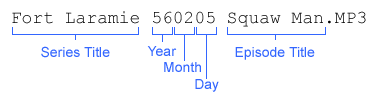
This episode from the series "Fort Laramie" was broadcast on February 5, 1956 with the episode title "Squaw Man"
Filenames of old time radio shows which are dated as yy-mm-dd. For example:
This episode from the series "Fort Laramie" was broadcast on February 5, 1956 with the episode title "Squaw Man"
George W Bush Disc A001
|
Add Audio CD to Cart - $5.00 |
George W Bush Disc A002
|
Add Audio CD to Cart - $5.00 |
George W Bush Disc A003
|
Add Audio CD to Cart - $5.00 |
George W Bush Disc A004
|
Add Audio CD to Cart - $5.00 |
George W Bush Disc A005
|
Add Audio CD to Cart - $5.00 |
George W Bush Disc A006
|
Add Audio CD to Cart - $5.00 |
George W Bush Disc A007
|
Add Audio CD to Cart - $5.00 |
George W Bush Disc A008
|
Add Audio CD to Cart - $5.00 |
George W Bush Disc A009
|
Add Audio CD to Cart - $5.00 |
George W Bush Disc A010
|
Add Audio CD to Cart - $5.00 |
George W Bush Disc A011
|
Add Audio CD to Cart - $5.00 |
George W Bush Disc A012
|
Add Audio CD to Cart - $5.00 |
George W Bush Disc A013
|
Add Audio CD to Cart - $5.00 |
George W Bush Disc A014
|
Add Audio CD to Cart - $5.00 |
George W Bush Disc A015
|
Add Audio CD to Cart - $5.00 |
George W Bush Disc A016
|
Add Audio CD to Cart - $5.00 |
George W Bush Disc A017
|
Add Audio CD to Cart - $5.00 |
George W Bush Disc A018
|
Add Audio CD to Cart - $5.00 |
George W Bush Disc A019
|
Add Audio CD to Cart - $5.00 |
George W Bush Disc A020
|
Add Audio CD to Cart - $5.00 |
George W Bush Disc A021
|
Add Audio CD to Cart - $5.00 |
George W Bush Disc A022
|
Add Audio CD to Cart - $5.00 |
George W Bush Disc A023
|
Add Audio CD to Cart - $5.00 |
George W Bush Disc A024
|
Add Audio CD to Cart - $5.00 |
George W Bush Disc A025
|
Add Audio CD to Cart - $5.00 |
George W Bush Disc A026
|
Add Audio CD to Cart - $5.00 |
George W Bush Disc A027
|
Add Audio CD to Cart - $5.00 |
George W Bush Disc A028
|
Add Audio CD to Cart - $5.00 |
George W Bush Disc A029
|
Add Audio CD to Cart - $5.00 |
George W Bush Disc A030
|
Add Audio CD to Cart - $5.00 |
George W Bush Disc A031
|
Add Audio CD to Cart - $5.00 |
George W Bush Disc A032
|
Add Audio CD to Cart - $5.00 |
George W Bush Disc A033
|
Add Audio CD to Cart - $5.00 |
George W Bush Disc A034
|
Add Audio CD to Cart - $5.00 |
George W Bush Disc A035
|
Add Audio CD to Cart - $5.00 |
George W Bush Disc A036
|
Add Audio CD to Cart - $5.00 |
George W Bush Disc A037
|
Add Audio CD to Cart - $5.00 |
George W Bush Disc A038
|
Add Audio CD to Cart - $5.00 |
George W Bush Disc A039
|
Add Audio CD to Cart - $5.00 |
George W Bush Disc A040
|
Add Audio CD to Cart - $5.00 |
George W Bush Disc A041
|
Add Audio CD to Cart - $5.00 |
George W Bush Disc A042
|
Add Audio CD to Cart - $5.00 |
George W Bush Disc A043
|
Add Audio CD to Cart - $5.00 |
George W Bush Disc A044
|
Add Audio CD to Cart - $5.00 |
George W Bush Disc A045
|
Add Audio CD to Cart - $5.00 |
Please wait...
COMMENTS
Kurt
Leave a comment